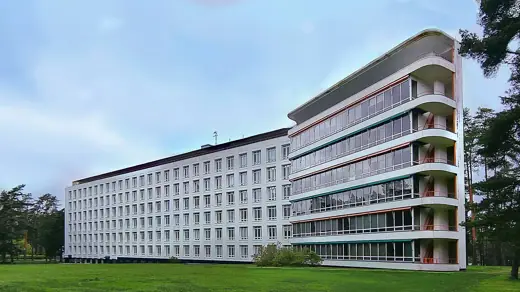
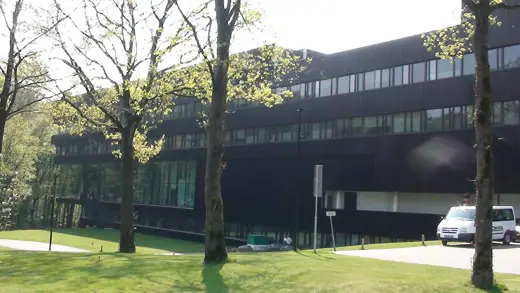
Paimio Sanatorium (Finnish: Paimion parantola; Swedish: Pemars sanatorium) is a former tuberculosis sanatorium in Paimio, Southwest Finland, designed by Finnish architects Alvar and Aino Aalto. The Aaltos won the architectural competition for the project in 1929, and the building was completed in 1933. It soon received critical acclaim both in Finland and abroad and became one of the best-known works of Finnish modernist architecture.
The Aaltos' starting point for the design was to make the building itself a contributor to the healing process. Alvar Aalto described the building as a "medical instrument". The design therefore paid unusual attention to the physical and psychological comfort of patients.
Patient bedrooms were designed to minimise disturbance and provide access to light and fresh air. Rooms generally accommodated two patients, with individual cupboards and washbasins. The washbasins were specially shaped to reduce noise when in use. Lighting was positioned so that patients lying in bed would not have a lamp directly in their field of vision, while the ceilings were painted a muted greyish-green to reduce glare.
The patient rooms also contained specially designed cupboards fixed to the walls and raised above the floor, making it easier to clean beneath them. These details demonstrate the Aaltos' approach of treating furniture, fittings and architecture as parts of a single design problem.