




Housing · Regionalism
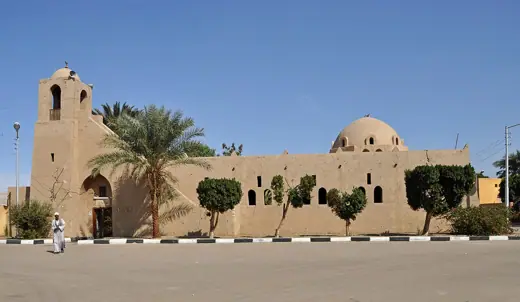
New Gourna Village
Key featuresMud-brick vaults and domes revived to house villagers cheaply.
About the building
Hassan Fathy built New Gourna, or New Qurna, between 1946 and 1952 to rehouse the people of Qurna, halfway between el-Gezira on the Nile and the Colossi of Memnon, on the main road leading to the Theban Necropolis. It was also an experiment in low-cost, environmentally friendly building. Fathy chose appropriate technology, above all mud brick construction. For its look he drew on traditional Nubian forms he had seen on a 1941 trip there, such as enclosed courtyards and vaulted roofs. The villagers were reluctant to move, since it cut them off from their trade in archaeological finds. The design, mixing traditional materials and methods with modern principles, was never finished, and of the original village only a few houses, the market and the mosque survive. In 2010 the World Monuments Watch named it among the most endangered sites.
Sources: Kurna · Hassan Fathy (Wikipedia)
More by Hassan FathyAll 2 →
More with earth & local materialAll 83 →
Find more with
Earth & local material83 buildings →Vault130 buildings →Low cost35 buildings →Housing264 buildings →Each opens every building that shares the idea.
Details
- Architect
- Hassan Fathy
- Place
- Luxor, Egypt
- Year
- 1948
- Typology
- Housing
- Movement
- Regionalism
- Region
- Middle East

Go deeper




More · HousingAll 264 →
Portrait: Dimitri Papadimos personal archive with his son Ioannis D.Papadimos · CC BY-SA 3.0 · source