




Culture & sport · Modernism
Nehru Centre
Key featuresCylindrical tower on a sloped, landscaped base; 1,000-seat auditorium, planetarium, exhibition galleries.
About the building
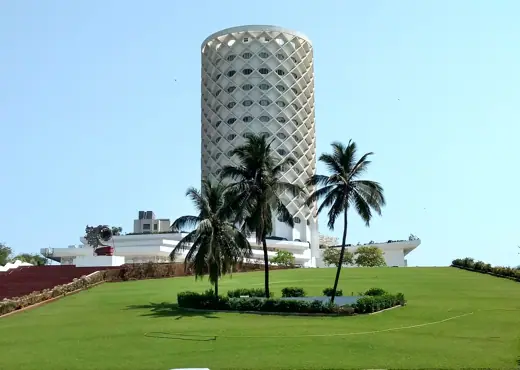
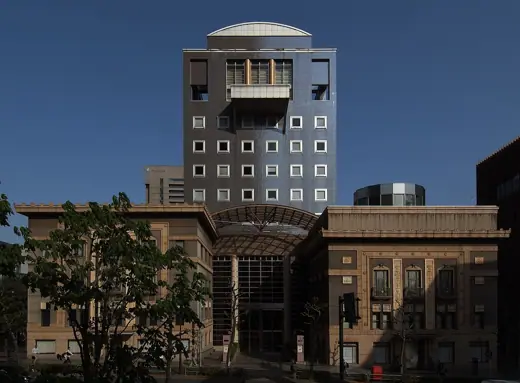
Nehru Centre in Mumbai promotes the ideas and teachings of Jawaharlal Nehru, India's first Prime Minister, through education and cultural programmes. Conceived in 1972, with Indira Gandhi laying its foundation stone, it was finished in 1985 on six acres in Worli for ₹9 crore, as a "living memorial" to Nehru. The architect I. M. Kadri centred it on a cylindrical tower that grows out of a rising, planted slope, a form meant to show Nehru's picture of India moving from farming to industry. A latticed jaali wraps the tower, its pattern drawn from the rose motif often linked with Nehru. Across roughly 322,000 sq ft, the centre holds a 1,000-seat auditorium, a planetarium commissioned in 1977, an art gallery, a library and research facilities, laid out in open-plan spaces with castellated beams to suit exhibitions and cultural events.
Sources: Nehru Centre (Wikipedia)
More with geometryAll 1061 →
Find more with
Geometry1061 buildings →Facade as skin828 buildings →Landscape736 buildings →Culture & sport614 buildings →Each opens every building that shares the idea.
Details
- Architect
- I. M. Kadri
- Place
- Mumbai, India
- Year
- 1985
- Typology
- Culture & sport
- Movement
- Modernism
- Region
- South Asia

Go deeper





See all 7 links

More · Culture & sportAll 614 →
Portrait: SaabHistory29 · CC BY-SA 4.0 · source