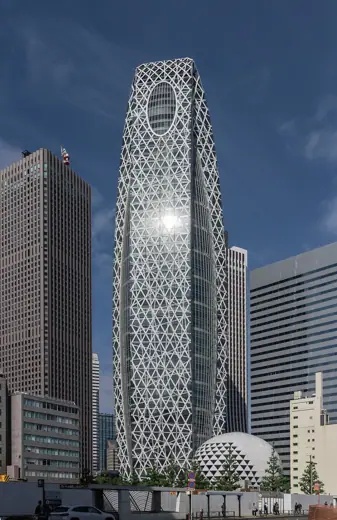
1/6 · Exterior · Cocoon TowerPhoto: Kakidai · CC BY-SA 4.0 · source2/6 · Exterior · Mode Gakuen Cocoon Tower in the evening with blue skyPhoto: Basile Morin · CC BY-SA 4.0 · source3/6 · Exterior · Cocoon Building, ShinjukuPhoto: Stephen Kelly from San Francisco, CA, USA · CC BY 2.0 · source4/6 · Exterior · Cocoon Building, ShinjukuPhoto: Stephen Kelly from San Francisco, CA, USA · CC BY 2.0 · source5/6 · InteriorPhoto: Nesnad · CC BY 4.0 · source6/6 · InteriorPhoto: Chihaya Sta · CC BY 4.0 · source
Key featuresAn elliptical tower of schools wrapped in a white web of curving diagonal bands, like a cocoon.
About the building
Mode Gakuen Cocoon Tower is a 50-storey school building, 204 metres tall, in Nishi-Shinjuku, Tokyo. When Mode Gakuen asked architects to compete for its new Tokyo site, it ruled that the building must not be rectangular. The winning team, led by Kenzo Tange's son Paul Noritaka Tange, proposed a curved shell of white aluminium and dark blue glass, crossed by a net of white diagonals. Tange Associates said the cocoon form stands for nurturing the students within, and that they hoped the tower would revive the area and link Shinjuku Station with the business district like a gateway. Each floor has three rectangular classrooms around a core of lift, stair and support shaft. Every three floors, a three-storey student lounge sits between the classrooms, facing east, southwest and northwest. Emporis named it Skyscraper of the Year for 2008.
Mode Gakuen Cocoon Tower (モード学園コクーンタワー, Mōdo gakuen kokūn tawā) is a 204-metre-tall (669-foot), 50-story educational facility located in the Nishi-Shinjuku district in Shinjuku, Tokyo, Japan.
Mode Gakuen invited architects to compete to build its new Tokyo location, stipulating that the building could not be rectangular. About 50 architects submitted more than 150 proposals. The winner had a curved shell of white aluminum and dark blue glass, criss-crossed by a web of white diagonal lines. The architects, Tange Associates, said its cocoon-like shape symbolizes nurturing the students inside; they also said they wanted the building to revitalize the surrounding area and to create a gateway between Shinjuku Station and the Shinjuku central business district. The building earned the firm the Emporis 2008 Skyscraper of the year award.
The building was designed by a team led by Paul Noritaka Tange, the son of Kenzo Tange. The building is home to three educational institutions: Tokyo Mode Gakuen (fashion vocational school), HAL Tokyo (special technology and design college), and Shuto Ikō (medical college). Completed in October 2008, the tower is the second-tallest educational building in the world and was the 17th-tallest building in Tokyo. It was awarded the 2008 Skyscraper of the Year by Emporis.