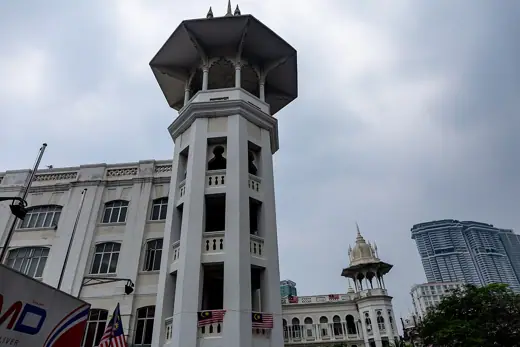
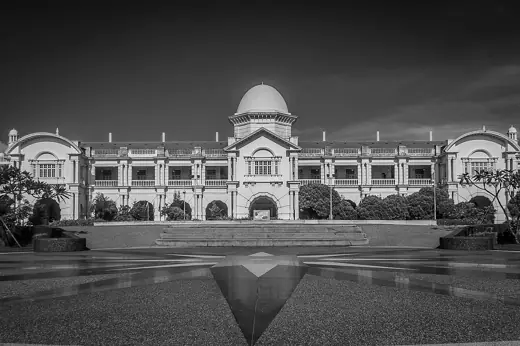
1/5 · Exterior · The Kuala Lumpur Railway StationPhoto: Own work · CC0 · source2/5 · Exterior · The Kuala Lumpur Railway StationPhoto: Own work · CC0 · source3/5 · Exterior · Kuala Lumpur railway station (Stesen keretapi Kuala Lumpur)Photo: Marcin Konsek · CC BY-SA 4.0 · source4/5 · Exterior · Kuala Lumpur railway station (Stesen keretapi Kuala Lumpur)Photo: Marcin Konsek · CC BY-SA 4.0 · source5/5 · Interior · Inside of Kuala Lumpur station and its platformsPhoto: A2613 · CC BY-SA 4.0 · source
Key featuresIndo-Saracenic mix of Western and Mughal styling: horseshoe and ogee arches and large corner chhatris.
About the building
Kuala Lumpur Railway Station went up between 1910 and 1917 on the site of an earlier station. It was the city's rail hub for the Federated Malay States Railways and then Malayan Railways (KTM), until Kuala Lumpur Sentral largely replaced it in 2001. Its designer, Arthur Benison Hubback, a British assistant to the Director of Public Works, drew on the region's Anglo-Asian architecture. The main block blends Western and Mughal elements in a "Raj" style close to Indo-Saracenic. Horseshoe and ogee arches and large corner chhatris (six, plus two added later) make it comparable to contemporaries such as the Sultan Abdul Samad Building. Unlike similar buildings in bare brick, it is fully plastered and painted in pale colours. Its original glazed roofs were partly open to let out locomotive smoke. It reopened as a railway museum on 31 August 2007.
The Kuala Lumpur railway station is a Malaysian railway station located in Kuala Lumpur. Construction began in 1910 and was fully completed in 1917. Replacing an older station on the same site, the station was Kuala Lumpur's railway hub in the city for the Federated Malay States Railways (FMSR) and its successor Keretapi Tanah Melayu (KTM) (English: Malayan Railways), before Kuala Lumpur Sentral station assumed much of its role in 2001. The station is notable for its architecture, adopting a mixture of Eastern and Western designs.
When originally completed in 1917, the Kuala Lumpur railway station consisted of a main terminal building at the front and three platforms serving four railway tracks at the back.
The main structure, which contains a main hall, ticket counters, railway offices and the railway hotel, is primarily designed in a "Raj" styling, mixture of Western and Mughal similar to Moorish Revival or Indo-Saracenic architecture. Dominated by horseshoe and ogee arches, and large chhatris (six originally, with two added later) at the corners of the building accompanying smaller variations at the front, the station is comparable to its contemporaries like the Sultan Abdul Samad Building, surrounding structures constructed around the Merdeka Square and the Railway Administration Building directly across the street.