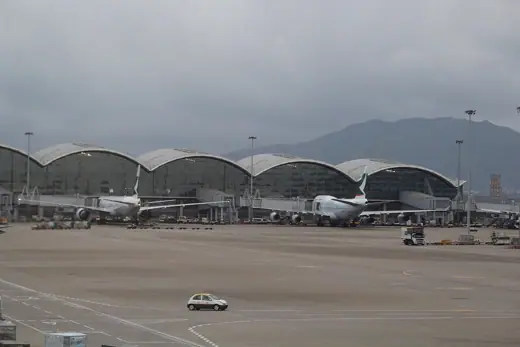
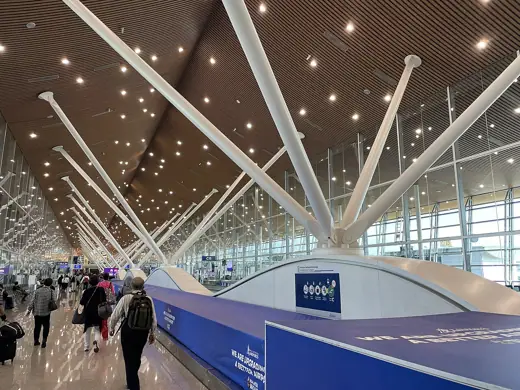
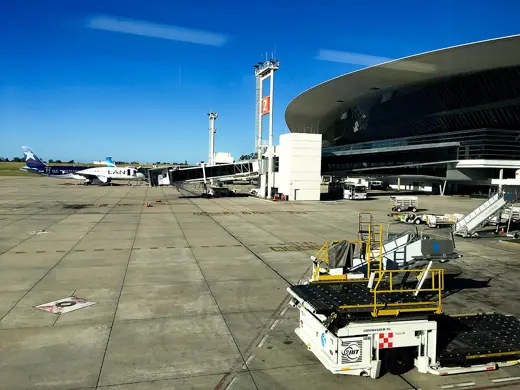
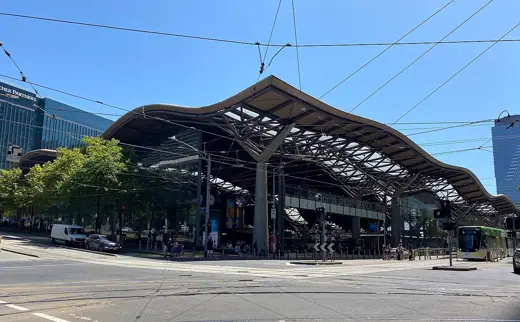
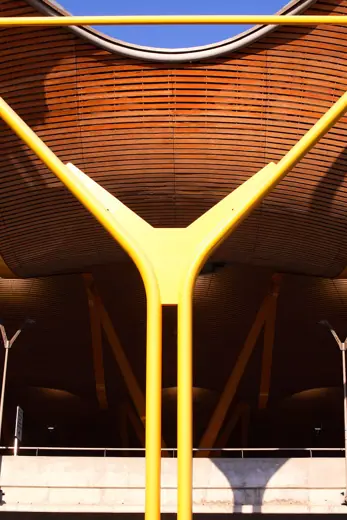
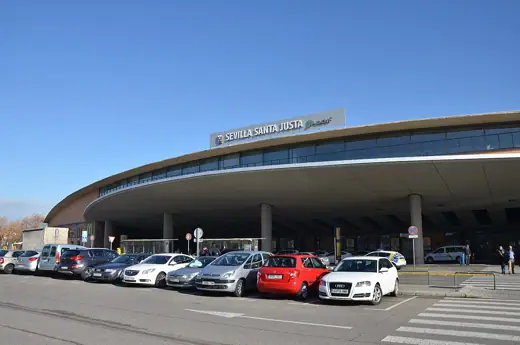
1/5 · Exterior · A view of part of the terminal buildings of Hong Kong International AirportPhoto: Katie Chan · CC BY-SA 3.0 · source2/5 · Exterior · Hong Kong AirportPhoto: Diego Delso · CC BY-SA 3.0 · source3/5 · Exterior · The Chek Lap Kok International Airport (Hong Kong, People's Republic of China)Photo: Ondřej Žváček · CC BY 2.5 · source4/5 · Interior · Hong Kong AirportPhoto: Diego Delso · CC BY-SA 3.0 · source5/5 · Interior · Interior of Hong Kong International AirportPhoto: Cheng-en Cheng · CC BY-SA 2.0 · source
Key featuresVast terminal under a repeated run of light steel barrel-vaulted roof shells that let daylight in.
About the building
Hong Kong International Airport, at Chek Lap Kok, was planned to replace Kai Tak, which dated from 1925. Building started in 1991 and the airport opened in 1998. The terminal's detailed design went to a consortium headed by Mott Connell, Mott MacDonald's Hong Kong office, with Foster and Partners as architects, BAA PLC for airport-specific design and Ove Arup for the roof structure. Terminal 1 covers 570,000 square metres. It was the largest passenger terminal anywhere when the airport opened and is still one of the biggest, after the likes of Dubai's and Beijing Capital's Terminal 3. Its mostly glass sides were made to break in high winds, letting pressure out so the terminal can survive a severe typhoon. For all its size it was designed for convenience, with its layout and signs, moving walkways and an automated people mover.
Hong Kong International Airport (IATA: HKG, ICAO: VHHH) is an international airport located on the island of Chek Lap Kok in western Hong Kong. It is sometimes referred to Chek Lap Kok Airport to distinguish it from its predecessor, Kai Tak Airport.
Opened in 1998, Hong Kong International Airport is the world's busiest cargo gateway and one of the world's busiest passenger airports. It is also home to one of the world's largest passenger terminal buildings, which was the largest when the airport opened.
The airport is operated by Airport Authority Hong Kong, and has three operational runways, each measuring 3.8 kilometres (2.4 mi) in length. It runs 24 hours a day and is the primary hub for Cathay Pacific, Greater Bay Airlines, Hong Kong Airlines, HK Express, and Air Hong Kong. The airport is one of the hubs of Oneworld, and also one of the Asia-Pacific cargo hubs for UPS Airlines. It is a focus city for Air China and China Eastern Airlines. Ethiopian Airlines, United Airlines and Emirates utilises Hong Kong as a stopover point for their flights.
As of March 2026, Hong Kong International Airport have connections with 80 destinations in 42 countries participating in the Belt and Road Initiative and direct connections to 220 destinations worldwide.