




Office & tower · Historic precedent
Hallidie Building
Key featuresOne of the country's first glass curtain walls.
About the building
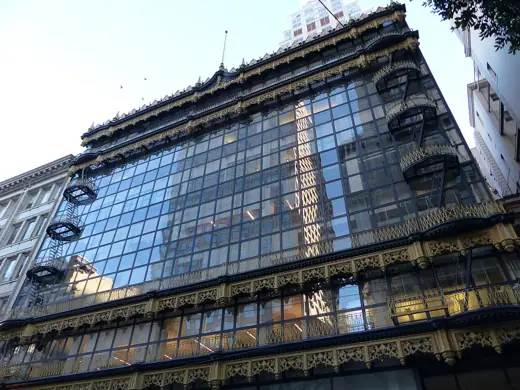
Named for Andrew Smith Hallidie, a pioneer of San Francisco’s cable cars, the Hallidie Building is a seven-storey office block at 130 Sutter Street in the city’s Financial District, designed by Willis Polk and opened in 1918. It is best known for its glazed front, symmetrical fire escapes and decorative ironwork. It has one of the first glass curtain walls in the United States, an early sign of the modern skyscraper, though Louis Curtiss’s Boley Clothing Company building of 1909, in Kansas City, Missouri, came first. The Crystal Palace may have inspired Polk; any other source is unclear. When a bank was weighing a much taller replacement in 1971, San Francisco’s Board of Supervisors declared it a historic monument. After the city judged its sheet-metal friezes, cornices, balconies and fire escapes unsafe, a two-year restoration followed, ending in April 2013.
Sources: Hallidie Building · Willis Polk (Wikipedia)
More by Willis PolkAll 2 →
More with facade as skinAll 828 →


Find more with
Facade as skin828 buildings →Steel & glass519 buildings →Detail553 buildings →Office & tower349 buildings →Each opens every building that shares the idea.
Details
- Architect
- Willis Polk
- Place
- San Francisco, United States
- Year
- 1918
- Typology
- Office & tower
- Movement
- Historic precedent
- Region
- Americas

Go deeper





See all 8 links


More · Office & towerAll 349 →
Portrait: Unknown author · Public domain · source