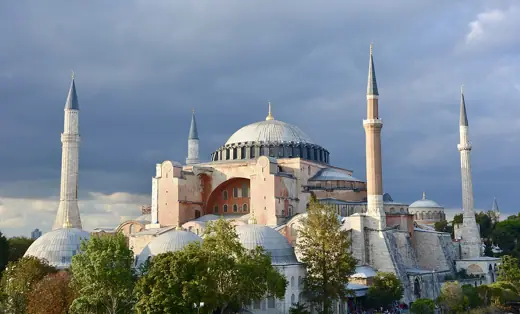
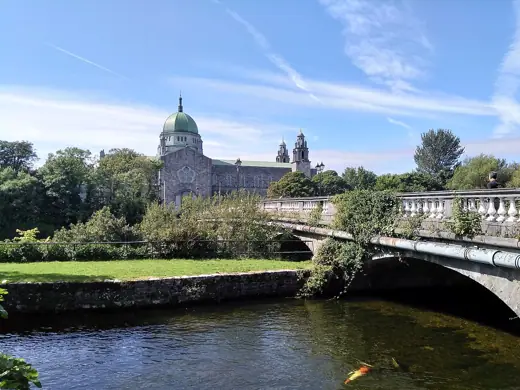
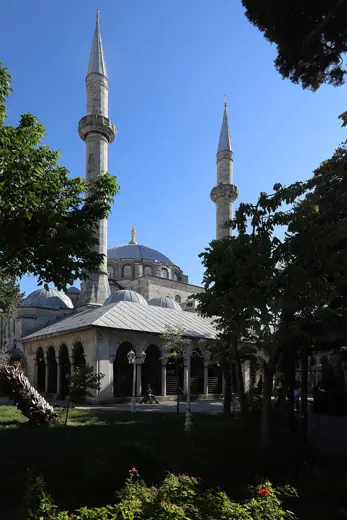
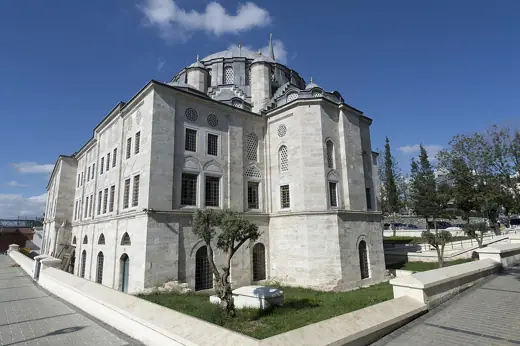
1/10 · ExteriorPhoto: Adli Wahid · CC BY-SA 3.0 · source2/10 · ExteriorPhoto: Arild Vågen · CC BY-SA 3.0 · source3/10 · ExteriorPhoto: lienyuan lee · CC BY 3.0 · source4/10 · Interior · Look from the esonarthex into the Hagia Sophia Grand Mosque, Istanbul, TurkeyPhoto: Laurens R. Krol · CC BY 4.0 · source5/10 · Interior · Interior of the Hagia Sophia Grand Mosque, Istanbul, TurkeyPhoto: Laurens R. Krol · CC BY 4.0 · source6/10 · Detail · Five doors lead to the narthex and then onPhoto: Dosseman · CC BY-SA 4.0 · source7/10 · PlanPhoto: Sir Banister Fletcher (1866-1953) · Public domain · source8/10 · Section · Showing the height of the columns-piers and the diameter of the dome of Hagia SophiaPhoto: DragonTiger23 · CC BY-SA 3.0 · source9/10 · Section · Coupe longitudinale et vue sur l'atriumPhoto: Karagil · CC BY-SA 4.0 · source10/10 · Elevation · Saint Sophia, ConstantinopolisPhoto: Wilhelm Salzenberg (* 20. Januar 1803 in Münster; † 23. Oktober 1887 in Vernex-Montreux, Schweiz)
· Public domain · source
Key featuresOne of the first buildings with a fully pendentive dome, about 33 m across after rebuilding.
About the building
Emperor Justinian I commissioned two Byzantine Greek scholars, Isidore of Miletus and Anthemius of Tralles, to design this cathedral in Constantinople, built from 532 to 537. Neither was trained as an architect, but as scientists they could organise thousands of workers and rare materials, among them stone from Egypt, Syria and Libya and columns from temples in Rome. Because earlier churches here had burned, the new one used baked brick and mortar, tied in places with iron, and no wood. The plan joins the long body of a Roman basilica to a central dome raised on a drum, and Isidore, author of a commentary On Vaulting, is thought to have done much of the dome work. Earthquakes often cracked it; part of the dome fell in 558. Isidore's nephew, Isidore the Younger, later repaired it and added the dome's ribs.
Hagia Sophia, officially the Hagia Sophia Grand Mosque, is a mosque and a major cultural and historical site in Istanbul, Turkey. It was formerly a church (360–1453) and a museum (1935–2020). The last of three church buildings to be successively erected on the site by the Eastern Roman Empire, it was completed in AD 537, becoming the world's largest interior space and among the first to employ a fully pendentive dome. It is considered the epitome of Byzantine architecture and is said to have "changed the history of architecture". From its dedication in 360 until 1453, Hagia Sophia served as the cathedral of Constantinople in the Byzantine liturgical tradition, except for the period 1204–1261 when the Latin Crusaders installed their own hierarchy. After the fall of Constantinople in 1453, it served as a mosque, having its minarets added soon after. The site became a museum in 1935, and was redesignated as a mosque in 2020.
Hagia Sophia is one of the greatest surviving examples of Byzantine architecture. Its interior is decorated with mosaics, marble pillars, and coverings of great artistic value. Justinian had overseen the completion of the greatest basilica ever built up to that time, and it was to remain the largest church for 500 years until the completion of the abbey church at Cluny in the 12th century.