Civic · Historic precedent
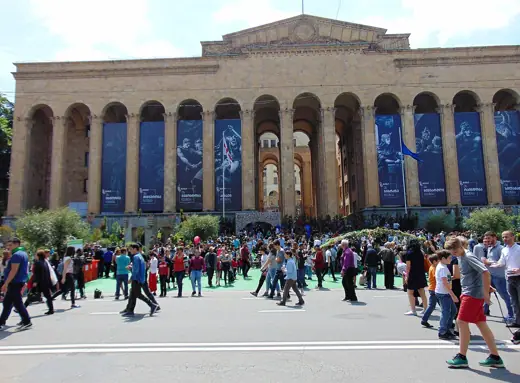
Parliament of Georgia (Rustaveli Avenue)
Key featuresReinforced concrete clad in tufa and granite, with a monumental arcade and arch pediment.
About the building
At 8 Rustaveli Avenue in Tbilisi, near the foot of Mount Mtatsminda, this complex was built as the House of Government of Soviet Georgia. It took the place of the demolished 19th-century Alexander Nevsky Cathedral and its churchyard, where Georgian cadets killed in the Bolshevik invasion of 1921 were buried. Viktor Kokorin and Giorgi Lezhava designed the upper building, put up from 1933 to 1938; with Vladimer Nasaridze they added the lower one along the avenue from 1946 to 1953. A courtyard with stairs and fountains joins the two. Both draw heavily on traditional Georgian architecture, and the avenue front is a monumental arcade under heavy eaves. Light reinforced concrete is faced with tufa, granite and other materials. Badly damaged in the coup of 1991–92, the complex was restored and housed Georgia's parliament from 1997 to 2012.
Sources: Georgian Parliament Building (Tbilisi) (Wikipedia)
More with monumentalityAll 909 →
Find more with
Monumentality909 buildings →Stone524 buildings →Axis319 buildings →Civic375 buildings →Each opens every building that shares the idea.
Details
- Architect
- Viktor Kokorin, Giorgi Lezhava
- Place
- Tbilisi, Georgia
- Year
- 1953
- Typology
- Civic
- Movement
- Historic precedent
- Region
- Middle East