Key featuresBastioned Renaissance fort of coral stone, its plan laid out like a human figure on a coastal ridge.
About the building
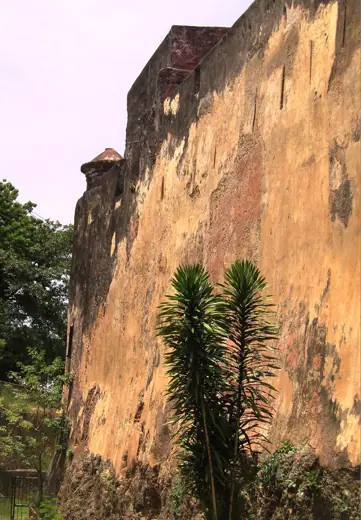
Built in 1593–1596 to guard the Old Port of Mombasa, Fort Jesus was ordered by Spain's King Felipe II, who also reigned over Portugal, and designed by the Italian Giovanni Battista Cairati. Cairati drew on the Italian architect Pietro Cataneo; Gaspar Rodrigues was master builder. Though the design is Renaissance, local Swahili people are believed to have supplied the masonry techniques, materials and labour. From above, the fort is shaped like a man: a rough square with a bulwark at each corner, regarded as a high point of late Renaissance military fortification. No European-style fort outside Europe had been built to resist cannon fire before it. The walls stand 18 m high; the Portuguese built them to 15 m, and the Omani Arabs added 3 m when they captured it. UNESCO declared it a World Heritage Site in 2011.
Fort Jesus (Portuguese: Forte Jesus de Mombaça; Swahili: Boma la Yesu la Mombasa), is a fort located on Mombasa Island. Designed by the Italian architect Giovanni Battista Cairati, it was built between 1593 and 1596 by order of King Felipe II of Spain, who also reigned as King Filipe I of Portugal and the Algarves, to guard the Old Port of Mombasa. Fort Jesus is the only fort maintained by the Portuguese on the Swahili coast and is recognised as a testament to the first successful attempt by a Western power to establish influence over the Indian Ocean trade.
Cairati, inspired by Italian architect Pietro Cataneo, designed the fort, with the master builder being Gaspar Rodrigues. This was Cairato's last overseas work. Although the design of Fort Jesus is an example of Renaissance architecture, the masonry techniques, building materials, and labor are believed to have been provided by the local Swahili people. The fort, built in the shape of a man viewed from the air, is roughly square with four bulwarks at its corners and is considered a masterpiece of late Renaissance military fortification.