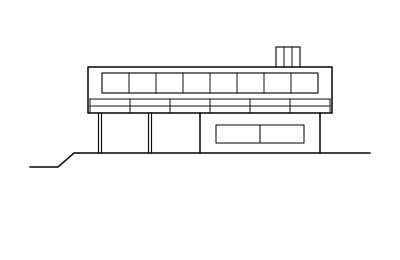
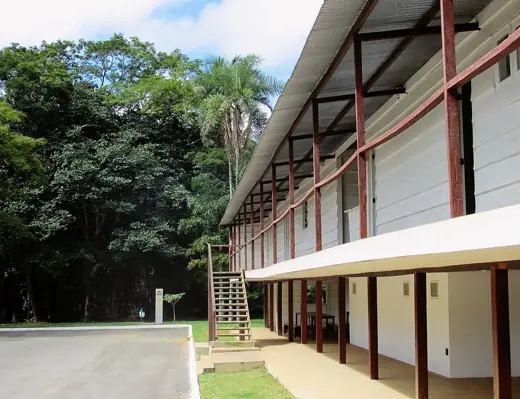
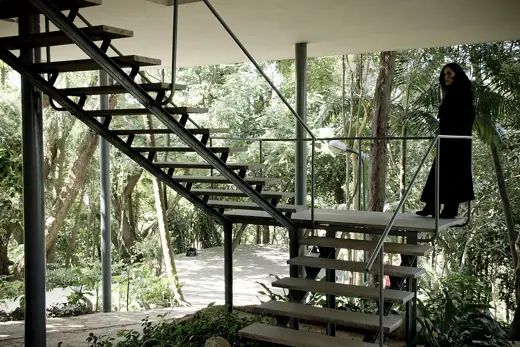
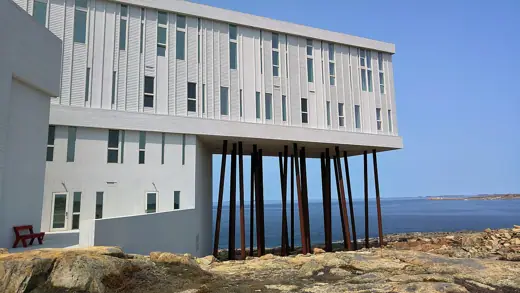
Key featuresGray's white seaside house: pilotis, a long window band and ship-like balcony rails, with furniture she designed.
About the building
Eileen Gray, an architect and furniture designer from Ireland, designed and built E-1027 at Roquebrune-Cap-Martin with the architect Jean Badovici between 1926 and 1929. The name encodes the pair: E for Eileen, 10 for Jean, 2 for Badovici and 7 for Gray. With its L-shaped plan, flat roof, floor-to-ceiling glazing and a spiral stair up to the guest room, the house is open yet compact. It is seen as Gray's first major work, blurring architecture and decoration and shaped around how its intended occupants would live. Gray also made furniture for it, among it a tubular steel table whose adjustable top caught crumbs. Le Corbusier painted vivid murals on the white walls in 1938 and 1939, which Gray regarded as vandalism. After a long restoration, the house opened to visitors in July 2021.
E-1027 is a modernist villa in Roquebrune-Cap-Martin, in the Alpes-Maritimes department of France. It was designed and built from 1926–1929 by the Irish architect and furniture designer Eileen Gray and the French/Romanian Architect Jean Badovici. L-shaped and flat-roofed with floor-to-ceiling windows and a spiral stairway to the guest room, E-1027 was both open and compact. This is considered to be Gray's first major work, making indistinct the border between architecture and decoration, and highly personalized to be in accord with the lifestyle of its intended occupants.
The name of the house, E-1027, is a code of Eileen Gray and Jean Badovici ('E' standing for Eileen, '10' Jean, '2' Badovici, '7' Gray), reflecting their relationship as lovers during its construction. It is impossible to identify the exact individual contributions of Gray or Badovici to E-1027. Gray also designed furniture for the house, including a tubular steel table which would enable her sister to eat breakfast in bed without leaving crumbs on sheets, due to an adjustable top that caught the crumbs.
Gray and Badovici separated shortly after the completion of the house and Badovici inherited the house in 1932. In 1938/1939, Le Corbusier painted significant murals in the house, which survive; Gray felt they were an act of vandalism.