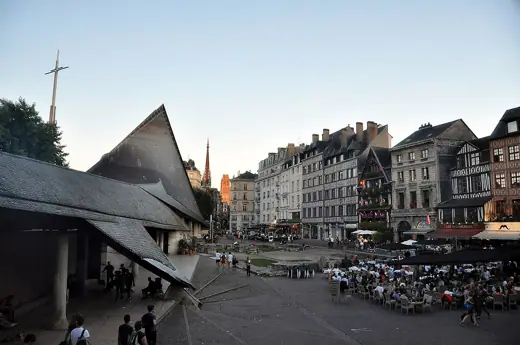
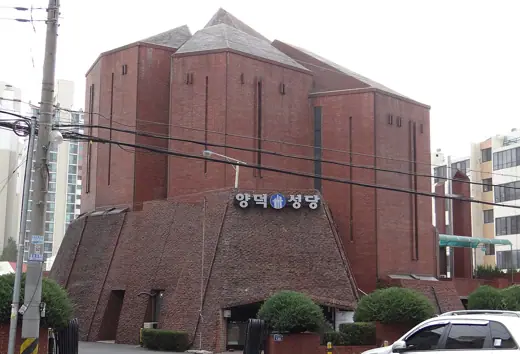
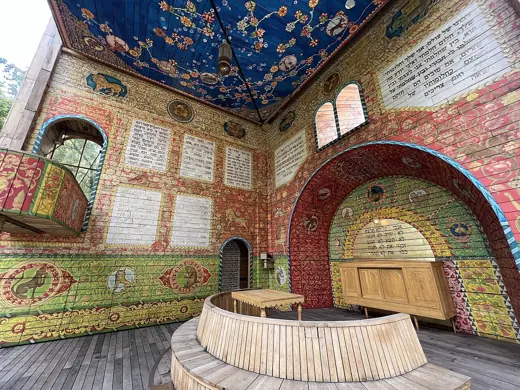
1/6 · Exterior · RouenPhoto: Herbert Frank from Wien (Vienna), AT · CC BY 2.0 · source2/6 · Exterior · Church of St Joan of Arc, RouenPhoto: Andy Li · CC0 · source3/6 · Exterior · Church of St Joan of Arc, RouenPhoto: Andy Li · CC0 · source4/6 · Exterior · Rouen 2025 - Église catholique Sainte-Jeanne-d'Arc -Photo: Raboe001 · CC BY-SA 3.0 · source5/6 · Interior · Interior of Church of St Joan of Arc, RouenPhoto: Andy Li · CC0 · source6/6 · Interior · Rouen 2025 - Église catholique Sainte-Jeanne-d'Arc -Photo: Raboe001 · CC BY-SA 3.0 · source
Key featuresSwooping slate roof like an upturned hull, set with 16th-century stained glass from a lost church.
About the building
This Catholic church stands in the centre of Rouen, in northern France, in the middle of the old market square, the Place du Vieux-Marché. It was here, in 1431, that Joan of Arc was condemned for heresy and put to death by burning. Louis Arretche received the commission in 1969 and designed both the church and the market halls beside it; the church was finished in 1979. Its sweeping curves are meant to recall the flames that killed Joan and an upturned longship. The tiled roof carries the same theme and shelters a walkway across the square. The stained glass came from the 16th-century Church of Saint Vincent, whose ruins lie a few metres away. That church was almost wholly destroyed in 1944, in the Second World War, but its windows had been removed and stored safely.
The Church of Saint Joan of Arc (French: L'église Sainte-Jeanne-d'Arc) is a Catholic church in the city centre of Rouen, northern France.
The church of Saint Joan of Arc was completed in 1979 in the centre of the ancient market square, known as the Place du Vieux-Marché, the place where Joan of Arc was burned at the stake for heresy in 1431. A small garden, Le Bucher ("The Pyre"), which is outside and to the north of the church marks the exact spot.
The modern church Sainte-Jeanne d'Arc and the adjacent market halls were designed by the architect Louis Arretche, who was commissioned in 1969. The sweeping curves of the structure are meant to evoke both the flames that consumed Joan of Arc and an overturned longship. Many early Christian churches were designed in the shape of an overturned boat. The market halls simultaneously resemble smaller overturned boats and fish with gaping mouths, which are also rich Christian symbols. The tiled roof echoes this theme and forms a covered walkway over the square.