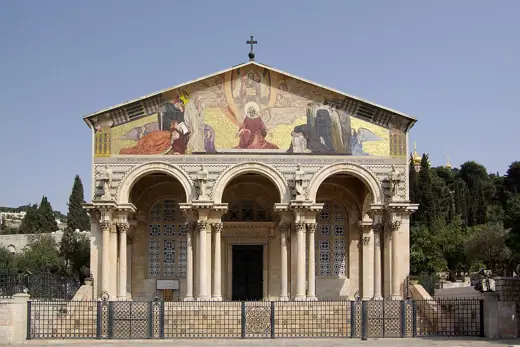
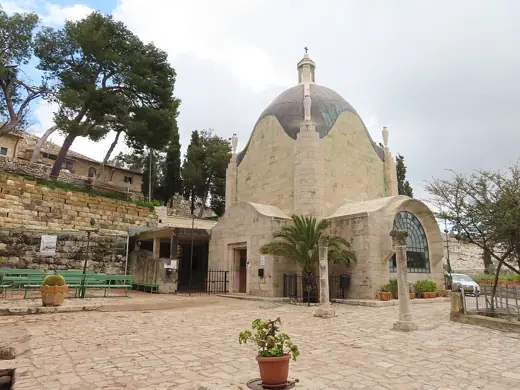
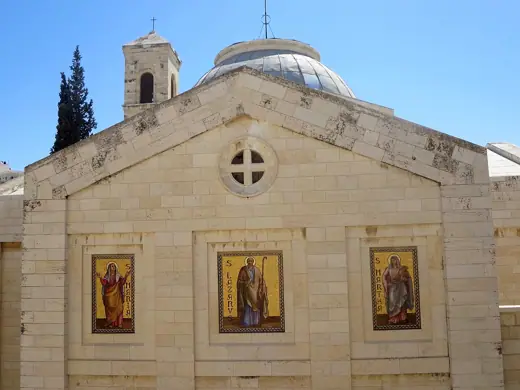
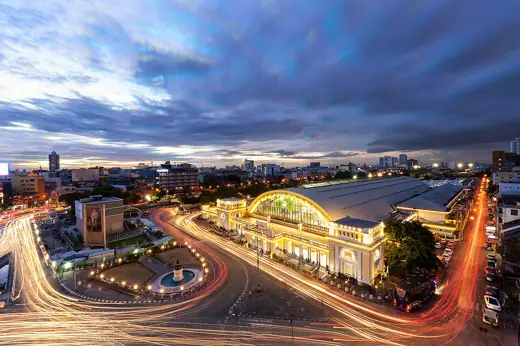
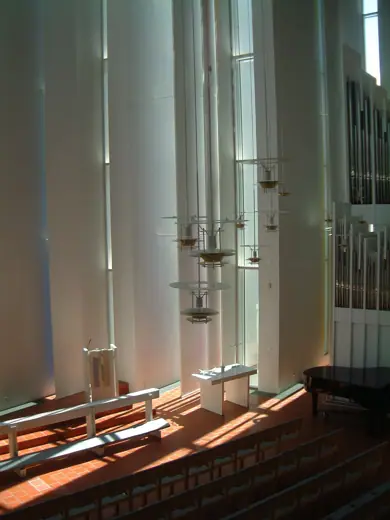
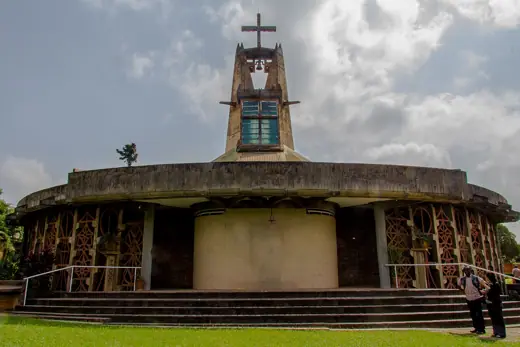
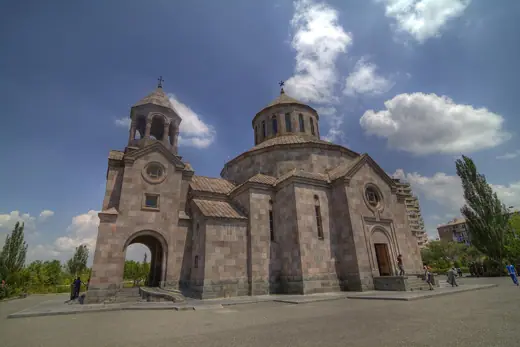
1/5 · Exterior · Jerusalem, Mount of Olives, Gethsemane, Church of all nationsPhoto: Berthold Werner · CC BY-SA 3.0 · source2/5 · Exterior · Jerusalem, Ölberg, Kirche aller NationenPhoto: Berthold Werner · Public domain · source3/5 · ExteriorPhoto: Matson Collection · Public domain · source4/5 · Exterior · Contre-jour view of the Church of All Nations , JerusalemPhoto: Bahnfrend · CC BY-SA 4.0 · source5/5 · InteriorPhoto: Matson Collection · Public domain · source
The Church of All Nations (Hebrew: כנסיית כל העמים; Arabic: كنيسة كل الأمم), also known as the Church of Gethsemane or the Basilica of the Agony (Latin: Basilica Agoniæ Domini), is a Catholic church located on the Mount of Olives in East Jerusalem, next to the Garden of Gethsemane. It enshrines a section of bedrock where Jesus is said to have prayed before his arrest. (Mark 14:32–42)
The church was built between 1919 and 1924 using funds donated from many different countries. The coat-of-arms of twelve of the countries from which donations originated are incorporated into the ceiling, each in a separate, small dome, and also into the interior mosaics. The countries honored in this way are, east to west (altar to entrance) and beginning with the northern apse: Argentina, Brazil, Chile and Mexico; in the middle of the church are commemorated: Italy, France, Spain and the United Kingdom, and to the right: Belgium, Canada, Germany, and the United States of America. The mosaics in the apses were donated by Ireland, Hungary, and Poland (by the sculpturist Tadeusz Adam Zieliński). The crown around the bedrock itself was a gift of Australia. These multi-national donations give the church one of its present names as the "Church of All Nations".