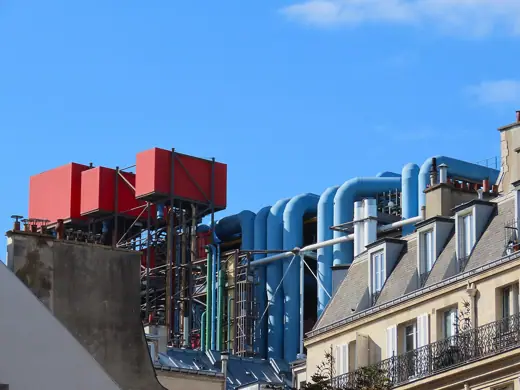
1/6 · Exterior · Le centre Pompidou depuis le jardin Anne-Frank, Paris, FrancePhoto: Rémih · CC BY-SA 4.0 · source2/6 · Exterior · Vue de Paris depuis la basilique du Sacré-Cœur de Montmartre, ParisPhoto: Chabe01 · CC BY-SA 4.0 · source3/6 · InteriorPhoto: Jean-Pierre Dalbéra · CC BY 2.0 · source4/6 · InteriorPhoto: Andrew H · CC BY 2.0 · source5/6 · Detail · Ventilation pipes on Place Georges Pompidou opposite the main entrance of the Centre Pompidou in ParisPhoto: Stefan Drößler · CC BY 4.0 · source6/6 · Sketch · croquis au stylo à bille et aquarelle d'après Street View / ballpoint and wash sketch from a Street ViewPhoto: Guy MOLL from Faro, Portugal · CC BY 2.0 · source
Portrait: Cirone-Musi ( Festival della Scienza , Genova) Color and edits by the uploader. · CC BY-SA 2.0 · source
About Centre Pompidou
The Centre Pompidou (French pronunciation: [sɑ̃tʁ pɔ̃pidu]), more fully the Centre national d'art et de culture Georges-Pompidou (lit. 'Georges Pompidou National Centre of Art and Culture'), also known as the Pompidou Centre in English and colloquially as Beaubourg, is a building complex in Paris, France. It was designed in the style of high-tech architecture by the architectural team of Richard Rogers, Su Rogers and Renzo Piano, along with Gianfranco Franchini. It is named after Georges Pompidou, the President of France from 1969 to 1974 who commissioned the building, and was officially opened on 31 January 1977 by President Valéry Giscard d'Estaing.
Centre Pompidou is located in the Beaubourg area of the 4th arrondissement of Paris. It houses the Bibliothèque publique d'information (BPI; Public Information Library), a vast public library, and the Musée National d'Art Moderne, the largest museum for modern art in Europe. The Place Georges Pompidou is an open plaza in front of the museum.
The Centre Pompidou was closed for renovation in September 2025. It is expected to reopen in 2030 upon the project's completion. The BPI will be temporarily relocated to its Lumière building.