




Office & tower · Contemporary
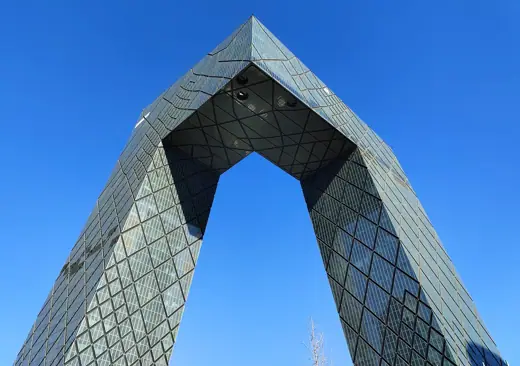
CCTV Headquarters

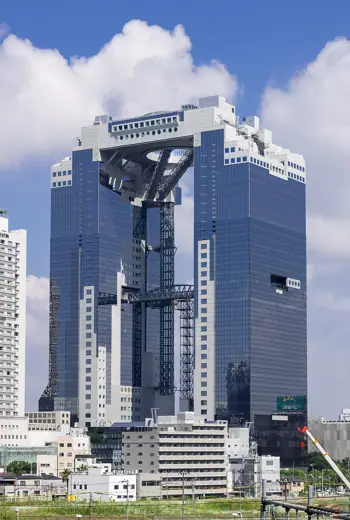
Key featuresA loop of two leaning towers joined by a 75-metre cantilever.
About the building
OMA designed the CCTV Headquarters in Beijing, with Rem Koolhaas and Ole Scheeren in charge and Cecil Balmond of Arup doing the complex engineering. OMA won the contract on 1 January 2002 after an international competition. Rather than a conventional tower, the main block is a loop of six sections, some horizontal and some vertical, with 473,000 m2 (5,090,000 sq ft) of floor space, giving the facade an irregular grid around an open centre. The loop is meant to stand for collectivity, communication, continuity and integration. Building it is seen as a structural challenge, not least because the site is in a seismic zone; the two towers were joined in the early morning, once their steel had cooled to one temperature. Work started on 1 June 2004 and the facade was done in January 2008.
Sources: CCTV Headquarters (Wikipedia)
More by OMAAll 26 →
More with cantileverAll 180 →
Find more with
Cantilever180 buildings →Structure as expression668 buildings →Megastructure70 buildings →Office & tower349 buildings →Each opens every building that shares the idea.
Details
- Place
- Beijing, China
- Year
- 2012
- Typology
- Office & tower
- Movement
- Contemporary
- Region
- East Asia
Go deeper





More · Office & towerAll 349 →
Portrait: Strelka Institute for Media, Architecture and Design from Moscow, Russia · CC BY 2.0 · source