


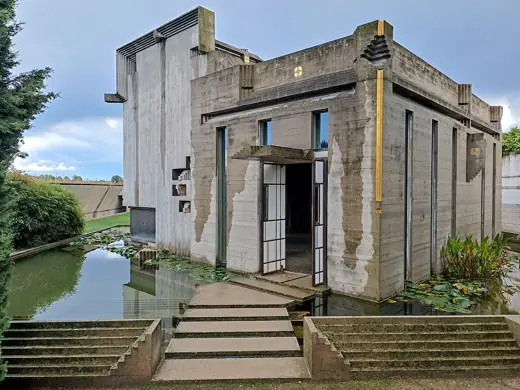


Religious · Late modernism
Brion Cemetery

Key featuresConcrete, water and interlocking circles: a lesson in detail and procession.
About the building
From 1968 to 1978 Carlo Scarpa worked on the Brion Cemetery in San Vito d'Altivole, an L-shaped addition of around 2,000 square metres to the municipal cemetery next to it. Onorina Tomasin-Brion commissioned it in 1969; she was the widow of Giuseppe Brion, who founded the Brionvega company. Scarpa held that 'the place for the dead is a garden', and the sanctuary is laid out as concrete buildings with distinctive details among gardens and water features. Its influences come in layers. Venetian ones include gold tiles of the kind known from Byzantine mosaics, while the chapel draws on the Japanese tea room. Scarpa himself lies buried beside the Brion sanctuary. Conservation work restoring the Brion tomb was finished in September 2021.
Sources: Brion Cemetery (Wikipedia)
More by Carlo ScarpaAll 7 →
More with detailAll 553 →
Find more with
Detail553 buildings →Water306 buildings →Exposed concrete542 buildings →Religious456 buildings →Each opens every building that shares the idea.
Details
- Place
- San Vito d'Altivole, Italy
- Year
- 1978
- Typology
- Religious
- Movement
- Late modernism
- Region
- Europe
Go deeper





See all 8 links


More · ReligiousAll 456 →
Portrait: Mario De Biasi (Mondadori Publishers) · Public domain · source