




Hospitality · Modernism
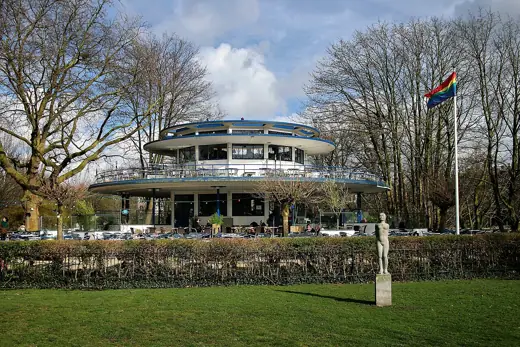
Blauwe Theehuis
Key featuresTwo stacked circular floors under a circular roof 'saucer'; concrete, steel and glass, with blue-painted pillars.
About the building
The Blauwe Theehuis, or Blue Tea House, is a Modernist pavilion from the 1930s in Amsterdam's Vondelpark. The brothers H.A.J. and Jan Baanders designed it in the Nieuwe Bouwen, or Nieuwe Zakelijkheid, style, the Dutch version of Bauhaus. Built of concrete, steel and glass, the ring-shaped building recalls a flying saucer: two round floors sit one above the other, and a round roof forms a third "saucer" on top. The eight-sided ground floor carries a twelve-sided upper floor, which was first the home of the owner. Twelve pillars hold up that upper level, and they, the balustrades and the roof edges are all painted blue. The pavilion is protected as a rijksmonument, a Dutch national monument.
Sources: Blauwe Theehuis (Wikipedia)
More with steel & glassAll 519 →
Find more with
Steel & glass519 buildings →Colour273 buildings →Geometry1061 buildings →Hospitality106 buildings →Each opens every building that shares the idea.
Details
- Architect
- H.A.J. Baanders and Jan Baanders
- Place
- Amsterdam, Netherlands
- Year
- 1937
- Typology
- Hospitality
- Movement
- Modernism
- Region
- Europe

Go deeper





See all 7 links

More · HospitalityAll 106 →
Portrait: Unknown photographer ; Volgens Stadsarchief Amsterdam Rechthebbende Auteursrecht · Public domain · source