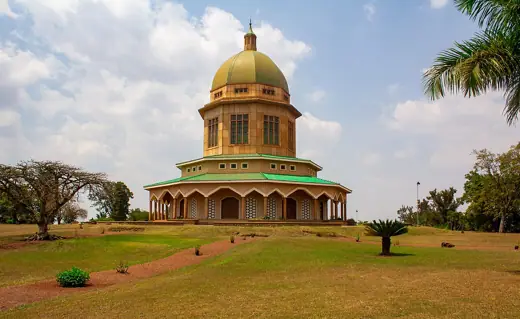
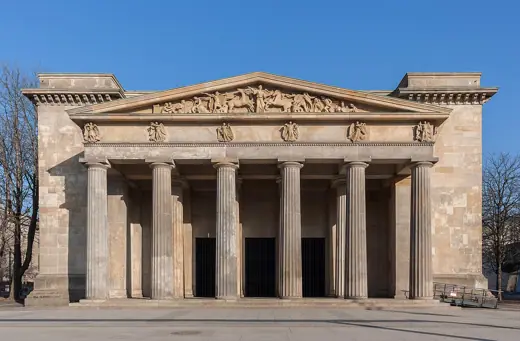
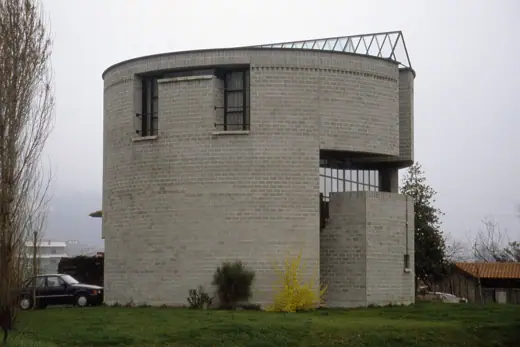
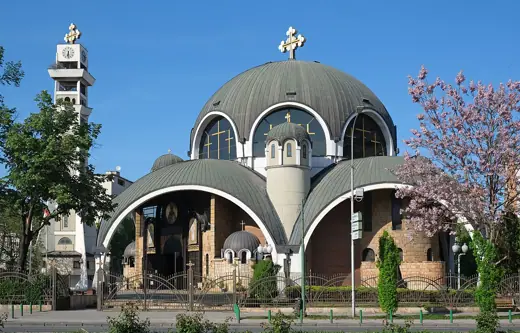
1/6 · ExteriorPhoto: Jameswasswa · CC BY-SA 4.0 · source2/6 · Exterior · The Bahá'í House of Worship in Kampala is the faiths main temple in AfricaPhoto: Scotted400 · CC BY-SA 4.0 · source3/6 · Exterior · This Baha'i House of Worship is found on Kikaaya Hill, Kampala, UgandaPhoto: Bxtst · CC BY-SA 3.0 · source4/6 · Exterior · Why does a Bahai temple have 9 sides?Photo: Jameswasswa · CC BY-SA 4.0 · source5/6 · Detail · There are 7 temples like this one in the world and an 8th one is in constructionPhoto: François Terrier from Zurich, Switzerland · CC BY 2.0 · source6/6 · Context · Bahai temple of Uganda was designed by Charles Mason Remey in late yearsPhoto: Jameswasswa · CC BY-SA 4.0 · source
Key featuresDomed temple 39 m high, with an Italian mosaic-tiled dome; stone, doors and benches from Uganda; dedicated 1961.
About the building
Bahá'ís call this House of Worship, on the edge of Kampala, Uganda, the "mother Temple of Africa". When Bahá'ís in Iran faced a wave of persecution in 1955 and an earlier plan became impossible, two other Houses of Worship were announced, in Kampala and Sydney. A first design was turned down, and Charles Mason Remey drew a new one in Haifa, directed by Shoghi Effendi; it was approved in August 1956. Dedicated in 1961, it was the third Bahá'í House of Worship finished anywhere and then East Africa's tallest building. Italian mosaic tiles cover the dome and Belgian tiles the lower roof, while the wall panels have windows of German glass in green, pale blue and amber. Ugandan timber went into the doors and benches, and Ugandan stone into the walls. Against earthquakes, the foundation reaches 3 metres down.
A Baháʼí House of Worship, or Baháʼí temple, is a place of worship in the Baháʼí Faith. It is also referred to as Mashriqu'l-Adhkár (Arabic: "Dawning-place of the remembrances of God").
All Baháʼí Houses of Worship share certain architectural elements, some of which are specified in Baháʼí scripture. ‘Abdu'l-Baha's instructions to the architect of the first House of Worship, in Turkmenistan, were that the design should feature nine aspects of the building which each incorporate the number nine, with nine sides, nine columns, nine piers, nine doors, nine gardens, nine paths, nine pools, nine covered walkways and nine loggias. A circular shaped building with nine sides, nine gardens, and nine paths has been retained as a requirement for all subsequent Houses of Worship. The number nine is symbolically significant in Baháʼí belief, in which it represents completeness, perfection, and the Baháʼí teaching of the unity of religion. The number nine also holds significance in the Baháʼí Faith due its numerical value of Bahá according to the abjad numeral system. In a letter dated 20 April 1955 referencing the House of Worship to be built in Germany, Shoghi Effendi indicated via his secretary that nothing in the Baháʼí teachings required a dome for the building.