

Palace · Historic precedent
Amer Fort
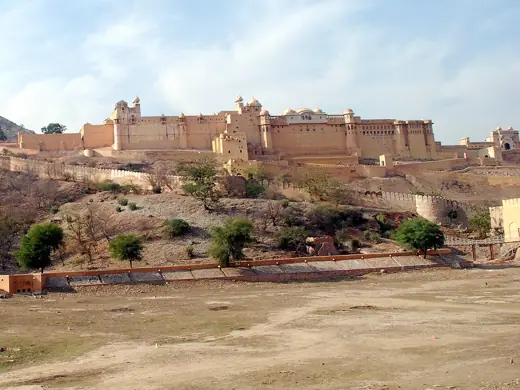
Key featuresRed sandstone and marble on four levels, each with a courtyard; Sukh Niwas cooled by water channels.
About the building
Raja Man Singh originally built Amer Fort, and Jai Singh I enlarged it in the early 1600s. Its ramparts, gates and cobbled paths overlook Maota Lake, the palace's main source of water. It is a fine case of Rajput architecture, with Mughal influence in parts. Built of red sandstone and marble, it rises over four levels, each set around a courtyard. Its parts include the Diwan-e-Aam for public audiences, a raised platform with 27 colonnades and elephant-shaped capitals; the Diwan-e-Khas for private ones; the Sheesh Mahal, or mirror palace; and the Sukh Niwas, cooled by breezes passing over an indoor water cascade. A tunnel, meant as a wartime escape route, links it to Jaigarh Fort, and the two count as one complex. Since 2013 it has been a UNESCO World Heritage Site within the Hill Forts of Rajasthan.
Sources: Amber Fort (Wikipedia)
More with courtyardAll 325 →
Find more with
Courtyard325 buildings →Water306 buildings →Stone524 buildings →Palace44 buildings →Each opens every building that shares the idea.
Details
- Architect
- Man Singh I
- Place
- Jaipur, India
- Year
- 1592
- Typology
- Palace
- Movement
- Historic precedent
- Region
- South Asia