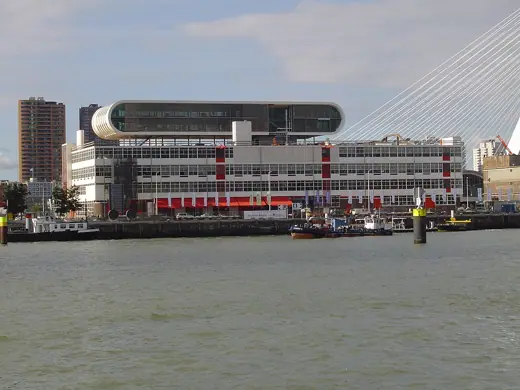
Van den Broek en Bakema was a Rotterdam architecture practice that played a leading part in rebuilding the Netherlands after the Second World War. It grew from the office of Brinkman & Van der Vlugt, whose work Jo van den Broek carried on from 1936; in 1948 he brought in Jaap Bakema (1914–1981). Named Van den Broek en Bakema from 1951, the firm made its name with the Lijnbaan shopping street in Rotterdam (1953) and the plan for a city on the artificial island of Pampus (1965). Bakema was also a member of Team 10 and an editor of the magazine Forum. The office continues today as Broekbakema.
Read moreShow less
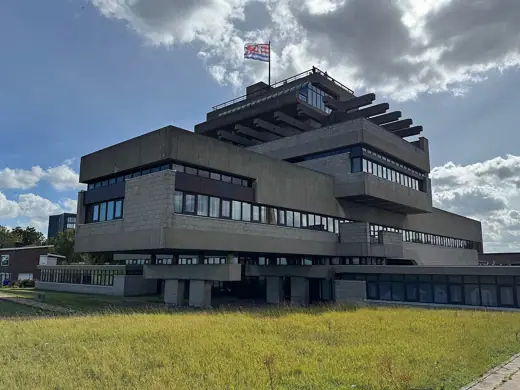
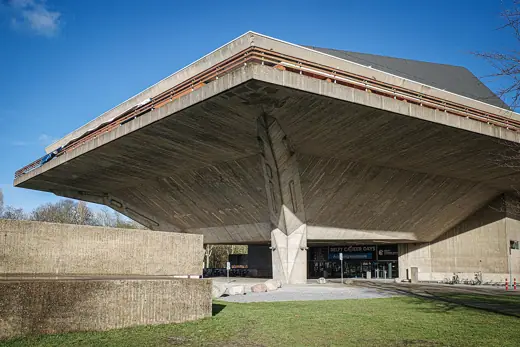
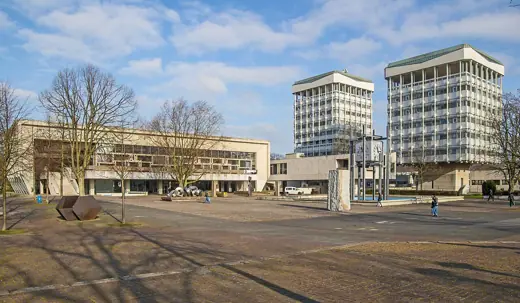
The Aula TU Delft (1966), one of the few brutalist buildings left in the Netherlands, cantilevers a 34.5-metre concrete hall for 1,040 seats on mainly two columns. Marl Town Hall (1967) sets a council wing under a 60-metre folded roof of prestressed concrete, as an open, non-authoritarian town hall. Terneuzen City Hall (1972), on the dike along the Westerschelde, recalls a great ship; Bakema put the citizens' hall on the top floor and called it "a hospitable house of chunky material".