Guide · Drawings
How to develop an architecture concept, from brief to form
An architecture concept is the one idea that decides how your building answers its brief and its site, and you should be able to say it in a single sentence. You develop it by reading the brief, the site and the programme until you find the problem that matters most, choosing one clear response to it, and testing that response quickly in sketches and rough models. A concept is working when it starts making decisions for you, in the plan, the section and even the details. At the jury you say the sentence first, then show where the idea appears in every drawing.
What a concept is, and what it is not
A concept is a reason, not a shape. "A building that looks like a leaf" is an image. "A reading room under one deep roof, because the site faces the hot afternoon sun" is a concept: it names a condition and a response, and it tells you what to draw next. That is a made-up example, as is every example here that isn't linked to a real building.
A concept is also not a concept diagram. The diagram shows the idea to someone else; the idea has to exist first. For the drawing side, see our concept diagram ideas.
Good concepts come from this brief and this site, are simple enough to remember, and are specific enough to rule things out. Avoid words that could describe any project, like "a dialogue between old and new".
Start with the brief, the site and the programme
Ideas come from reading what you were given closely enough to notice what is difficult or unusual about it.
- The brief. Read it twice: once for what it asks, once for what it leaves open. Underline the words that carry values ("community", "a place to linger"), not only the numbers. If you can't say in your own words what the project is for, ask your tutor before you design.
- The site. Visit, walk it, draw it. Look for the one or two conditions any good building here would have to answer: a slope, a busy edge, a view, an old tree, harsh sun, a neighbour that needs respect. Our site analysis guide covers what to look at.
- The programme. List the spaces, then look at how they relate: which need each other, which must be apart, which are public, which need daylight. The most interesting part is often a conflict, such as a school that should be open to its neighbourhood and safe for its children.
Then write one line each: what the brief wants, what the site demands, what the programme struggles with. Your concept usually sits where two of them meet.
Find one idea
Ideas usually come from one of these places. Pick one and let it lead.
- The site. For example, a made-up library on a sloping site that steps down the hill so each reading floor has its own entrance.
- The programme. For example, a made-up school where the corridor widens into a street for lessons outside the classroom.
- Light and climate. How the building takes in or shuts out sun, air and rain.
- Structure and material. One way of building that shapes everything, such as heavy walls under a light roof.
- People and culture. Something about the users: a ritual, a craft, a way of gathering.
Write the idea as a sentence with "because" in it: because of this condition, the building does this. If it takes two sentences, you probably have two ideas and need to choose; keep the other in your sketchbook.
Don't settle on the first idea just to have one. Sketch three different responses to the same problem and compare them before you commit.
Test it in sketches and models
An idea in words can't fail. Draw it and build it as soon as you can, so that it has the chance to.
- Quick sketches in plan, section and perspective, many to a page. What is it like to arrive, to move through, to stand in the main space?
- Rough models in card or foam, made in an hour, not a week. They show what a sketch hides: how big the roof is, where shadows fall.
- Change one thing at a time, or you won't know which change helped.
- Keep everything. Date your sketches and photograph every model; the path to the final form is part of your jury story.
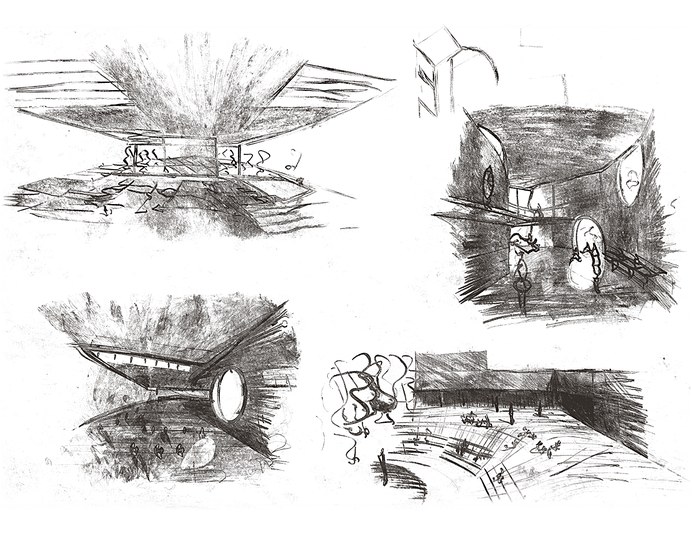
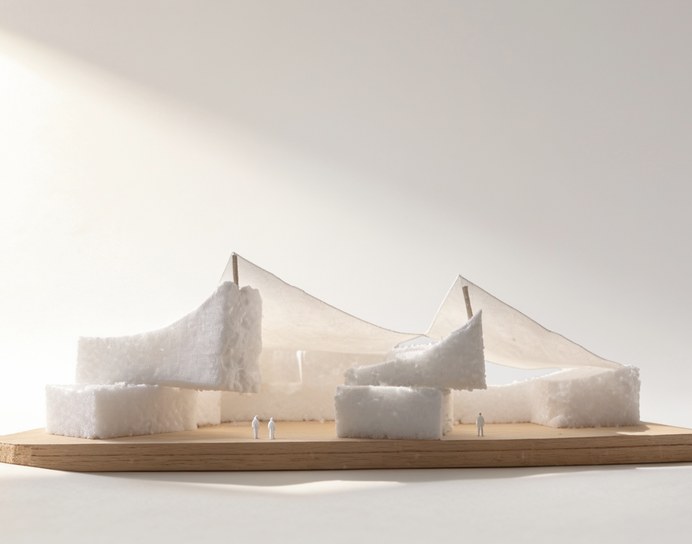
In the Law Garden sample, the student's intent was to anchor community and identity for the vendors of a cloth market in Ahmedabad. Their process sheet says the work started with exploratory sketches and models of sequences of spaces, and shows three models: a space hovering over the market, a court at the centre, and fabric screening. Fabric, seen as the vendors' identity, became a tensile roof on masts over the whole centre.
How to know when it is working
- It makes decisions for you. Unsure where the stair goes or how big a window should be? The idea suggests an answer.
- It survives the brief. Every room fits, at the right size, without the idea breaking.
- It shows in plan and section, not only in an elevation or a render.
- Someone else can say it back. Show a classmate one sketch and ask what the idea is.
It isn't working if you need a paragraph to explain it, if it only works from one viewpoint, or if you started from a shape and found the reason afterwards. Simplify it, or go back to one of your other ideas; changing concept hurts more the later you leave it.
Carry it through plan, section and detail
A concept that lives only in the first diagram reads as a slogan. A strong one shows at every scale: how the building meets the street, how the plan is organised, light and levels in section, and the joint or material where the idea becomes something you can touch. Ask of each drawing: where is the idea here?
Well-known buildings carry it all the way down:
- Kimbell Art Museum, Fort Worth: the galleries are concrete vaults, each split along its top by a slot that lets in daylight, bounced off reflectors across the curved ceilings. The light isn't added to the rooms; it is built into the structure that makes them.
- Church of the Light, Ibaraki: a cross cut into the concrete wall behind the altar, floor to ceiling and wall to wall, lined up with the joints of the concrete. Light is the only ornament, and the restraint reaches the benches and floorboards, made from scaffolding used in the construction.
- Sydney Opera House: Utzon won the competition in 1957, but it was 1961 before the design team settled on cutting every shell from a single sphere, so that arches of different lengths could share one mould. The idea held; the geometry that made it buildable had to be found.
- Villa Savoye, Poissy: Le Corbusier's Five Points of Architecture in a single house, with a ramp, seen from nearly everywhere inside, that climbs to the living floor and on to the roof terrace. A concept can be a set of rules, as long as every part follows them.
Our guide to presenting plans and sections shows how to draw them so the idea reads.
Explain it at the jury
- Say the sentence in the first minute, before the plans: the condition, then the response.
- Show where it came from: the site finding or programme problem.
- Show the testing, including one model you rejected and why. Jurors trust an idea that has been tested.
- Point to it in every drawing: "here, in the section, is where the light comes in".
- Be honest about where it is weak. If part of the building doesn't follow the idea, say why.
There is more on the talk itself in our jury presentation tips. Once the drawings are done, Studio FGA can set your own sketches, models and drawings on an editable A1 board and in a jury deck, from $6.49. It works only from what you upload, so the concept stays yours.
Questions students ask
What is a concept in architecture?
It is the main idea that shapes a design: a response to the brief, site or programme that guides decisions about form, plan, section and material. It is usually said in one sentence and shown in a few diagrams, and it should be visible in the finished drawings.
How do I know if my architecture concept is strong enough?
A strong concept is specific to your project, fits in one sentence and helps you make decisions. Check that it shows in your plan and section, not only your render, and that a classmate can explain it back after seeing one sketch.
What if my tutor rejects my concept?
Ask what exactly isn't working: the idea, or the way it is drawn and explained. Often the idea is sound but vague, and making it more specific is enough. If it really doesn't fit, go back to your other ideas; showing why you changed course makes a good story at the jury.