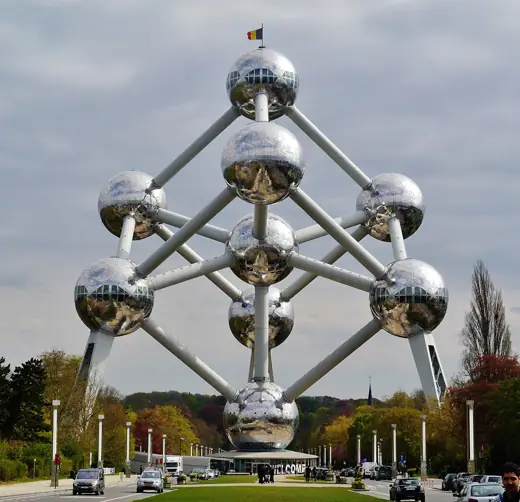
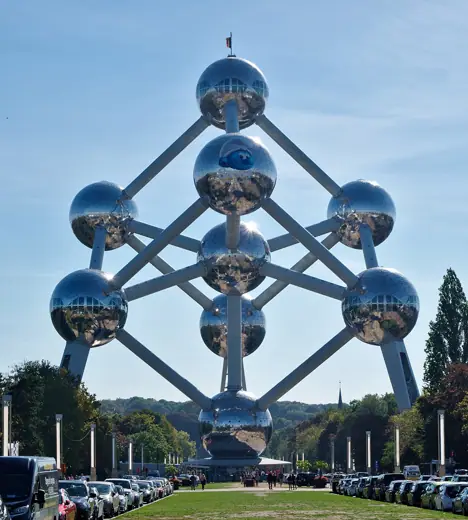
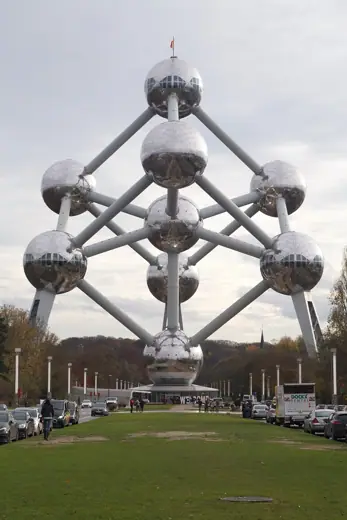
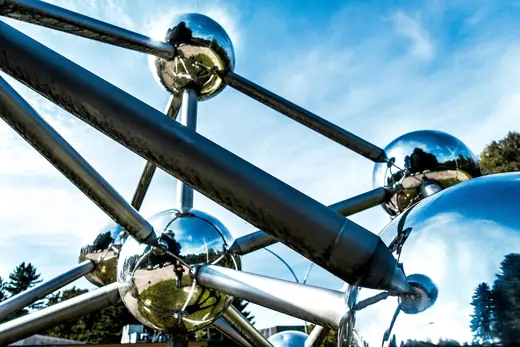
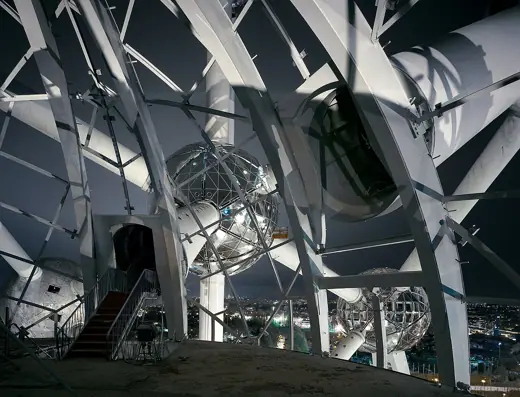
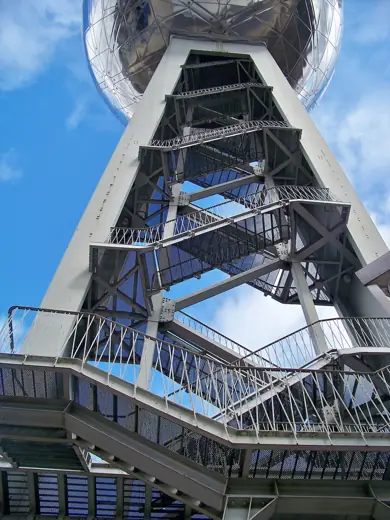
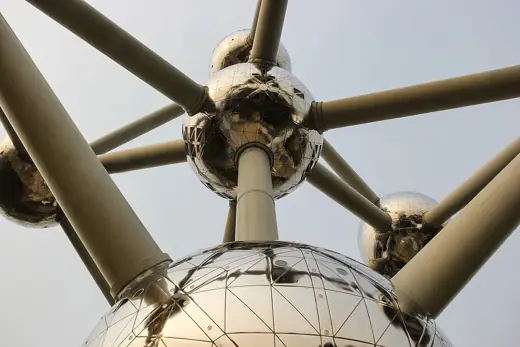
1/7 · Exterior · Atomium, Brussels, District of Laeken, Region of Brussels, BelgiumPhoto: Zairon · CC BY-SA 4.0 · source2/7 · Exterior · This photo of immovable heritage has been taken in the Brussels Capital RegionPhoto: Trougnouf (Benoit Brummer) · CC BY 4.0 · source3/7 · ExteriorPhoto: Tom Parnell from Scottish Borders, Scotland · CC BY-SA 2.0 · source4/7 · Exterior · Atomium modelPhoto: Ralf Steinberger from Milan, Berlin + Munich, Italy + Germany · CC BY 2.0 · source5/7 · InteriorPhoto: Mfplissart · CC BY-SA 4.0 · source6/7 · Interior · Atmomium stairsPhoto: halfuur · CC BY 3.0 · source7/7 · Detail · Das Atomium in Brüssel , wurde zur Expo 58 errichtetPhoto: Axel Kirch · CC BY-SA 4.0 · source
Pavilion · Modernism
Atomium
Andre Waterkeyn, Andre Polak · Brussels, BE · 1958
Key featuresNine steel spheres in an iron-crystal arrangement, linked by tubes with escalators.
The Atomium ( ə-TOH-mee-əm, French: [atɔmjɔm], Dutch: [aːˈtoːmijəm]) is a landmark modernist building in Brussels, Belgium, originally constructed as the centrepiece of the 1958 Brussels World's Fair (Expo 58). Designed by the engineer André Waterkeyn and the architects André and Jean Polak as a tribute to scientific progress, as well as to symbolise Belgian engineering skills at the time, it is located on the Heysel/Heizel Plateau in Laeken (northern part of the City of Brussels), where the exhibition took place. It is the city's most popular tourist attraction, and serves as a museum, an art centre and a cultural destination.
The Atomium stands 102 metres (335 ft) tall, making it one of the tallest structures in Belgium. Its nine 18-metre-diameter (59 ft), stainless-steel-clad spheres are connected in the shape of a unit cell that could represent an iron (ferrite) crystal magnified 165 billion times. Steel tubes connecting the spheres enclose stairs, escalators and a lift to allow access to the six visitable spheres, which contain exhibit halls and other public spaces. The top sphere includes a restaurant with a panoramic view of Brussels. The building was completely renovated between 2004 and 2006 by the companies Jacques Delens and BESIX.



.jpg)
_-_Flickr.jpg)
.jpg)


