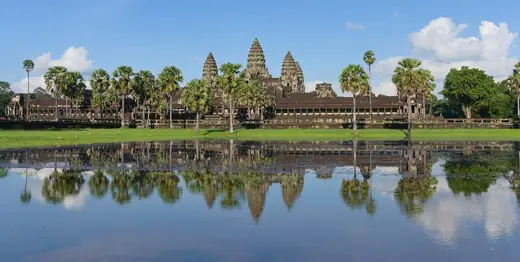
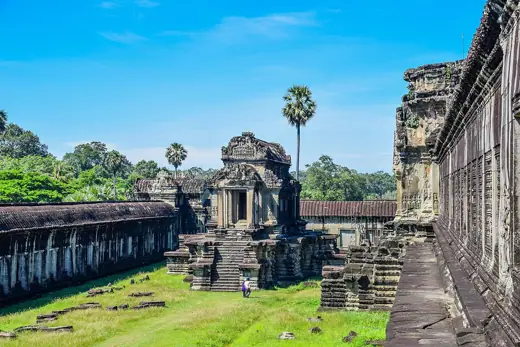
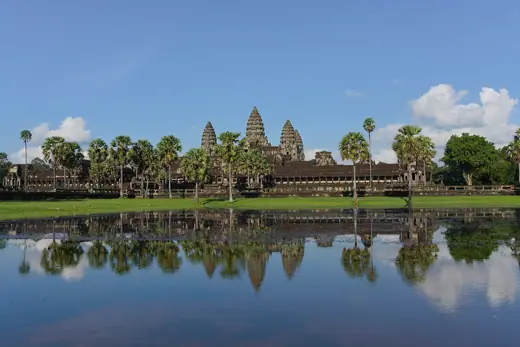
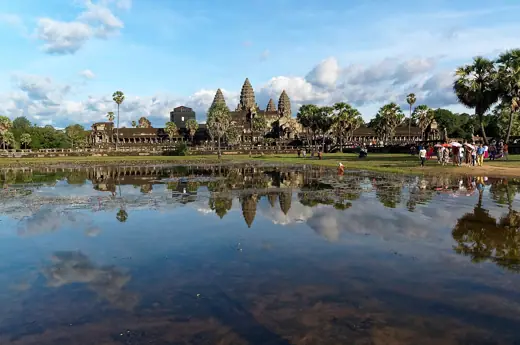
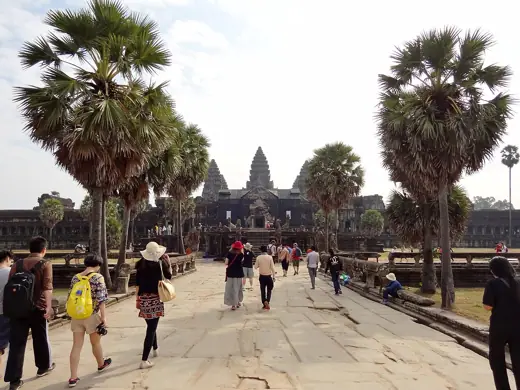
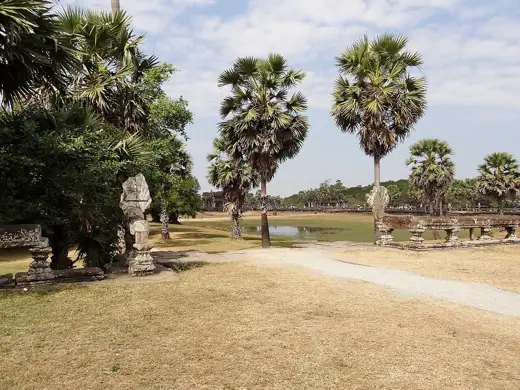
1/6 · Exterior · Angkor Wat with its reflectionPhoto: Satdeep Gill · CC BY-SA 4.0 · source2/6 · Exterior · Angkor Wat, Siem Reap Province, CambodiaPhoto: Krzysztof Golik · CC BY-SA 4.0 · source3/6 · Exterior · Angkor Wat with its reflectionPhoto: Satdeep Gill · CC BY-SA 4.0 · source4/6 · Exterior · View of the central structure of Angkor WatPhoto: Jakub Hałun · CC BY-SA 4.0 · source5/6 · InteriorPhoto: Olaf Tausch · CC BY 3.0 · source6/6 · InteriorPhoto: Olaf Tausch · CC BY 3.0 · source
Religious · Historic precedent
Angkor Wat
Khmer builders · Siem Reap, KH · c. 1150
Key featuresConcentric galleries and a wide moat lead along a west-facing axis to a quincunx of towers.
Angkor Wat (; Khmer: អង្គរវត្ត, 'City/Capital of Temples') is a Theravada Buddhist temple complex, originally built as a Vaishnava Hindu temple, in Siem Reap, Cambodia. It is the largest religious complex in the world. Located on a site measuring 162.6 hectares (1.6 km2; 401.8 acres) within the medieval capital of Angkor, it was constructed between 1113 and 1150 CE during the reign of the Khmer king Suryavarman II as a Hindu temple dedicated to Vishnu. From the late 13th century onward, the complex was gradually transformed into a Buddhist temple as Khmer kings adopted Buddhism. Angkor Wat has remained a Buddhist monastery and an active center of Buddhist worship into the present day. It is noted for its monumental scale, extensive bas-reliefs, and an architectural unity characteristic of Khmer architecture. Unlike most Angkorian temples, it is oriented toward the west. It is a symbol of Cambodia and appears on the Cambodian national flag.
Angkor Wat is a Buddhist temple complex. Located on a site measuring 162.6 ha (1,626,000 m2; 402 acres) within the ancient Khmer capital city of Angkor, it is considered as the largest religious structure in the world by Guinness World Records.


.jpg)


