Guide · Portfolios
Architecture portfolio vs jury board: what goes where
A jury board and a portfolio page can show the same project, but they are made for different readers in different situations. The board is read on a wall, at a distance, while you explain it. The portfolio is read alone, close up, on a screen or a small printed page, often in a hurry. That difference decides what goes on each, and it is why shrinking your boards into a PDF rarely makes a good portfolio.
Different readers, different time
The jury board has one project, one audience and one occasion. The jurors know the brief, often know the site, and have you standing next to the board ready to explain. They will spend several minutes with it, at a distance of a metre or two.
The portfolio has several projects and readers you will never meet: an admissions panel, a practice looking at applications, a scholarship committee. They don't know your brief or your site, you aren't there to explain, and they often give a first look of a few seconds per page before deciding whether to read more closely. They look at it on a laptop or phone, or printed at A4 or A3.
So a board can rely on you and on the brief. A portfolio page has to stand on its own.
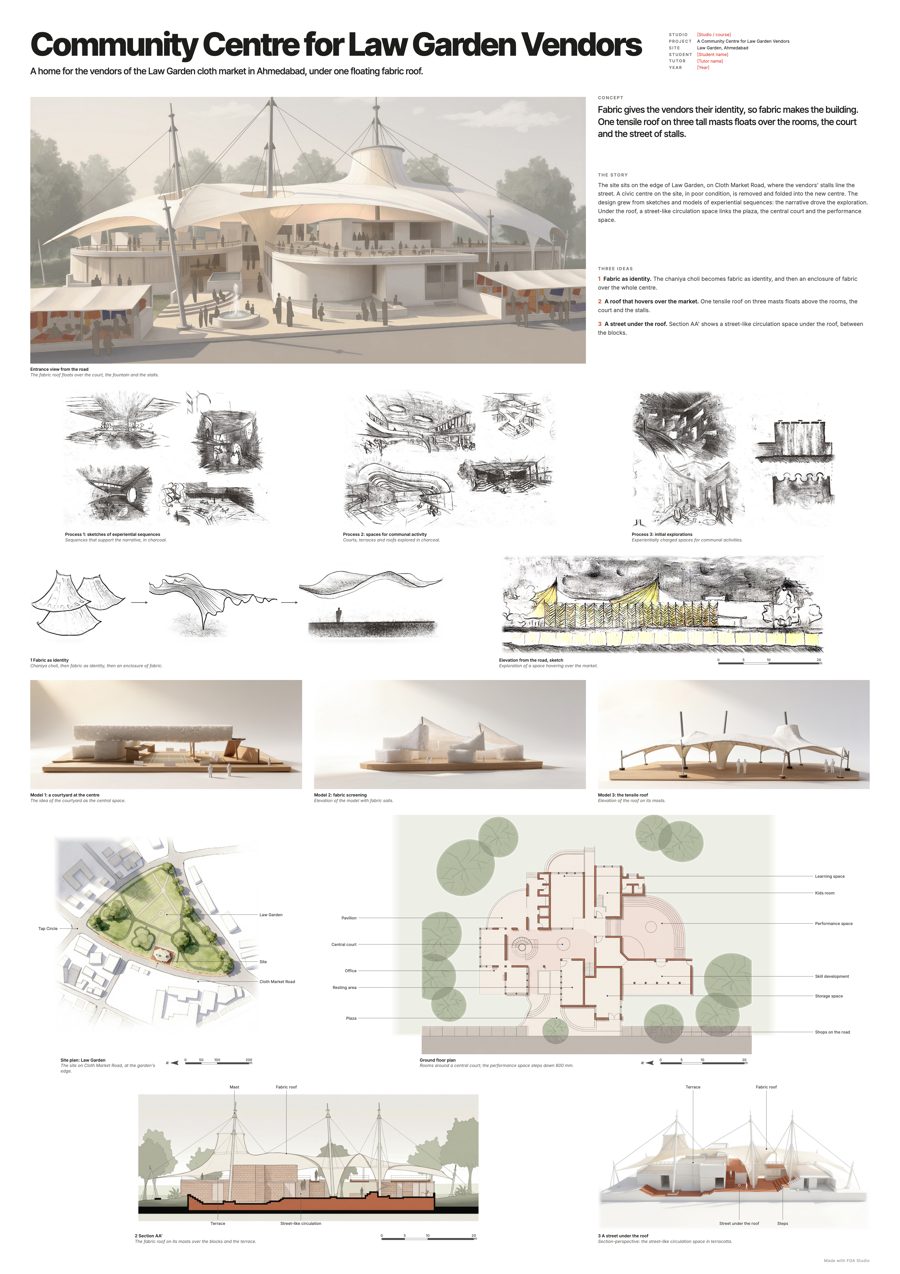
What goes on the jury board
- The idea, stated in a sentence near the hero image.
- The complete set of drawings the brief asks for: plans, sections, elevations, site plan, at the required scales.
- Enough site and context to explain the decisions, since jurors will ask about them.
- Details and technical drawings if the studio asks for them.
- Selected process work that explains a turning point.
The board is a complete account of one project at a moment in time. It is allowed to be dense, as long as it reads in order.
What goes in the portfolio
- Your best projects, not all of them. Three to five strong projects usually show more than eight uneven ones.
- For each project, the few images that carry it: often a hero image, a plan, a section, and one or two images of the key space or detail. Two to six pages per project is a common range.
- One or two lines of context: what the brief was, where, what year of study, how long. A stranger needs this; a juror didn't.
- Your role, clearly, on any group work. Say what you did yourself.
- Range. Sketches, physical models, technical drawings and built or competition work, if you have them, so readers see more than one way of working.
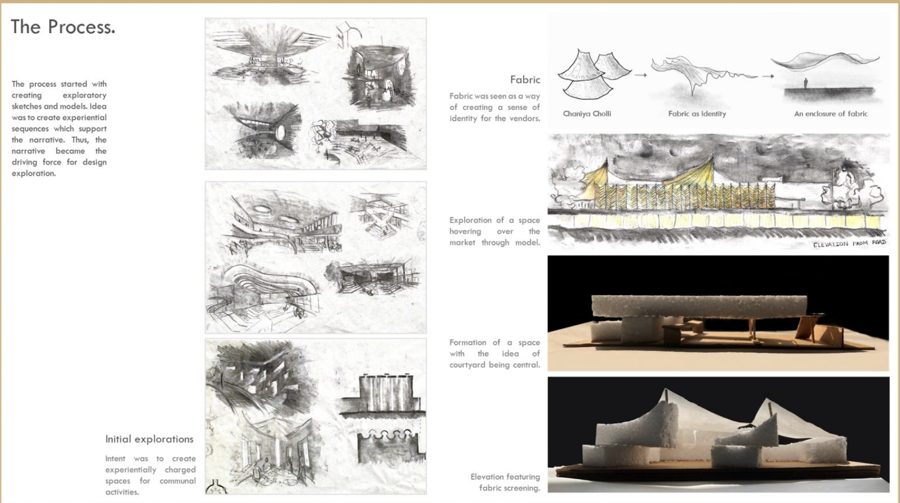
What changes when a board becomes portfolio pages
The common mistake is to export each A1 board as a single page and shrink it to fit A4 or a screen. At that size, captions are unreadable, line weights collapse into grey, and the reader sees a busy poster instead of architecture. Instead:
- Go back to the original drawings, not the board. Export each one again at the size it will appear on the page.
- Re-crop for the new format. A portfolio page is usually landscape A4 or A3, or a screen. A drawing that worked as a tall strip on a portrait board may need a different crop.
- Choose fewer drawings and show them larger. If a drawing needs zooming to read, it is too small.
- Rewrite the captions for a stranger. "Ground floor: the reading porch opens fully to the street" rather than "GF plan 1:200".
- Check line weights at the new size. A plan drawn for A1 at 1:100 and printed at a quarter of the width will need a lighter, simpler set of lines. See presenting plans and sections.
- Use one layout system across the whole portfolio: the same margins, grid and type, so different projects read as one body of work.
Your boards are still useful here. Their reading order tells you which drawings mattered most, and the hero of each board is often the opening image of that project in the portfolio.
What stays out of both
- Images you can't explain or didn't make, unless they are clearly credited (precedents, site photos by others).
- Every iteration. One or two process images that show a real change of direction are worth more than a page of similar massing models.
- Long paragraphs. Neither readers on a wall nor readers on a phone want them.
- Decorative graphics. Background textures, drop shadows and coloured panels compete with the drawings.
Working order that saves time
Make the jury board for the jury, from your drawings, laid out in your reading order. After the jury, while you still remember the feedback, make the portfolio pages for that project from the same drawings, revised if the jury pointed to something worth fixing. Doing this one project at a time is much easier than rebuilding three years of work in the week before an application deadline.
For the board side of that work, Studio FGA builds an A1 board and a jury deck from your drawings, in files you can edit, which gives you a laid-out starting point to then adapt. The portfolio pages are still worth making by hand, because the selection and the captions are where your own judgement shows.
A quick test for each
For a board: pin it up, step back two metres, and ask a classmate to tell you the idea in one sentence after a minute of looking. If they can, it works.
For a portfolio page: send it to someone who has never seen the project and ask them, after five seconds, what kind of building it is and what is special about it. If they can answer, the page is doing its job.
Questions students ask
Can I put my jury boards directly into my portfolio?
You can include an image of a board to show how you presented, but don't use shrunken boards as your main portfolio pages. Rebuild the pages from the original drawings at the size they will be seen.
How many pages per project in an architecture portfolio?
Two to six pages per project is a common range. Your strongest project can have more; minor ones fewer. Follow any page limit the school or practice sets.
What should a portfolio caption say?
What the reader should notice, in a line or two, plus the basics a stranger needs: project type, place, year of study and your role if it was group work.