Konstantin Melnikov (1890–1974) was a Russian architect and painter whose bold workers' clubs, garages and house made him one of the leading figures of the Soviet avant-garde of the 1920s. Though often grouped with the Constructivists, he was an independent artist who kept his distance from their group. In 1925 he designed the Soviet pavilion at the Paris decorative arts exhibition. In the 1930s he refused to conform to Stalinist architecture, withdrew from practice, and worked as a portrait painter and teacher for the rest of his life.
Read moreShow less
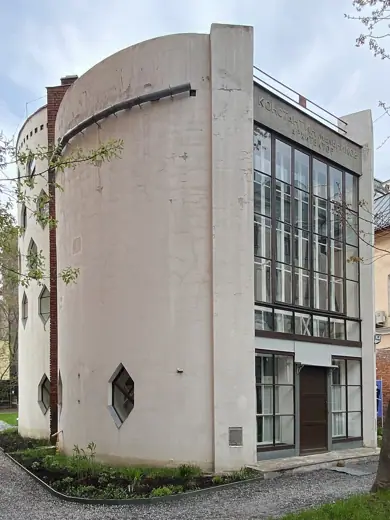
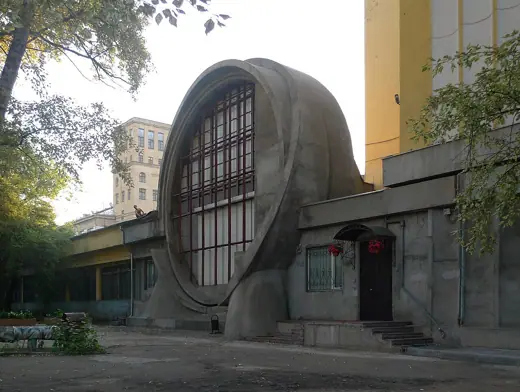
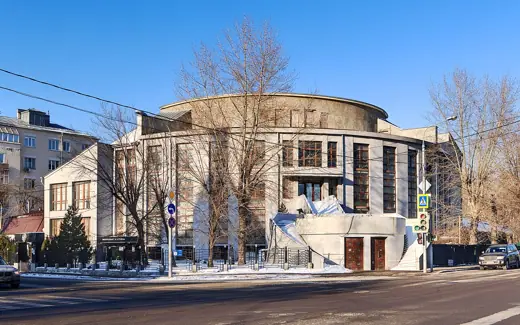
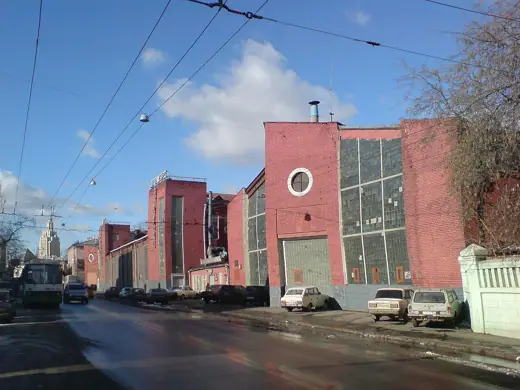
His workers' clubs could be divided into separate halls: the main hall of the Rusakov Workers' Club in Moscow (1928) splits into three. Melnikov House on Krivoarbatsky Lane (1929), his own home and finest surviving work, is two interlocking cylinders pierced by a pattern of hexagonal windows. For Moscow's buses and trucks he designed the Bakhmetevsky Bus Garage (1928), with an unusual parallelogram plan and a roof by the engineer Vladimir Shukhov, and the horseshoe-shaped Novo-Ryazanskaya Street Bus Garage (1929). Konstantin Melnikov's buildings are studied for original geometry and for plans that could change with use.