Félix Candela (1910–1997) was a Spanish-Mexican architect, born in Madrid, known for thin reinforced-concrete shells, called cascarones, often shaped as hyperbolic paraboloids that join form and structural efficiency. After fighting in the Spanish Civil War and being held in a camp at Perpignan, he emigrated to Mexico at 29. Many of his larger projects came from the Mexican government, and from 1971 to 1978 he taught at the University of Illinois at Chicago.
Read moreShow less
The Cosmic Rays Pavilion at the National Autonomous University of Mexico (1951), is an early work. Los Manantiales Restaurant in Mexico City (1958) is roofed with hyperbolic paraboloid shells. The Palacio de los Deportes in Mexico City (1968), built for that year's Olympic basketball tournament, covers a round hall with a dome 120 metres across, made of aluminium hyperbolic paraboloids clad in copper-sheathed plywood and carried on steel arches. At the age of 87 he designed the thin-shell roof of L'Oceanogràfic Restaurant in Valencia (2003), with the engineers Alberto Domingo and Carlos Lázaro, in a form that echoes Los Manantiales. Félix Candela's buildings are studied for how geometry lets thin concrete span great distances.
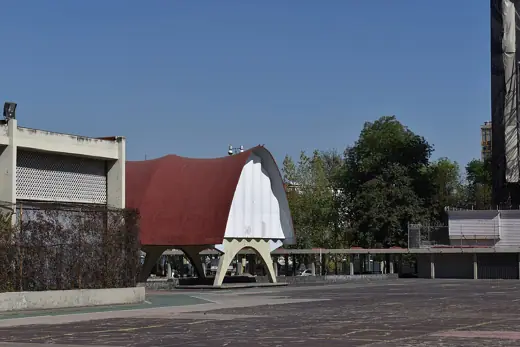 Cosmic Rays Pavilion1951 · Mexico City
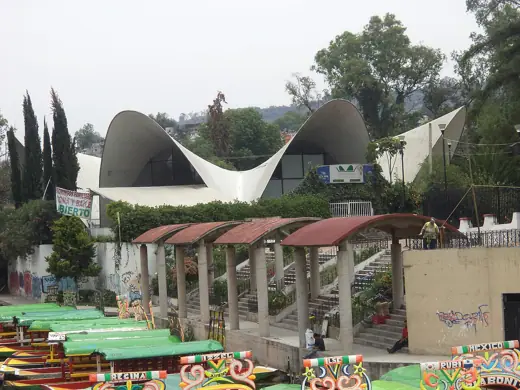 Los Manantiales Restaurant1958 · Mexico City
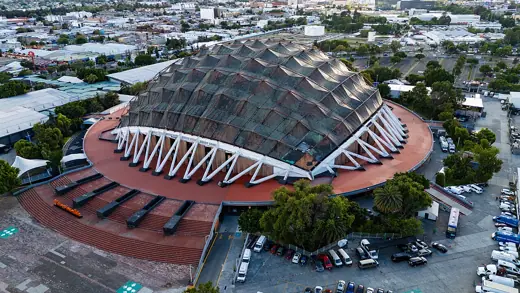 Palacio de los Deportes1968 · Mexico City
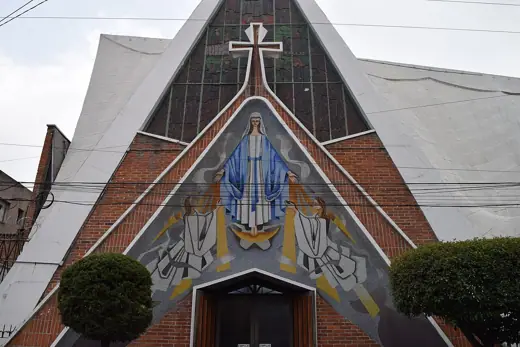 Church of La Medalla Milagrosa1955 · Mexico City
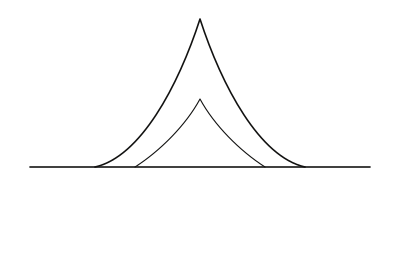 Open Chapel of Lomas de Cuernavaca (Palmira Chapel)1959 · Cuernavaca
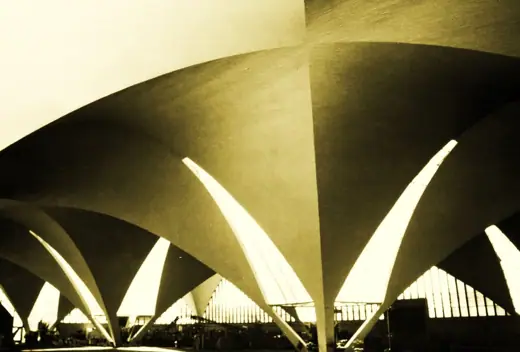 Bacardi Bottling Plant1960 · Cuautitlán
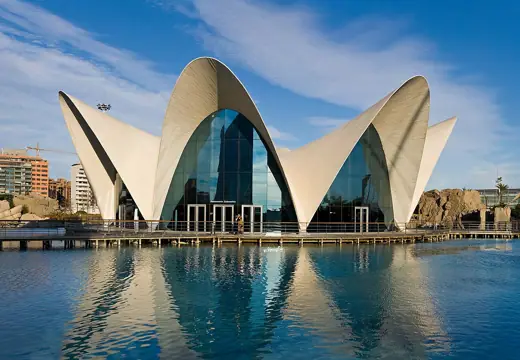 L'Oceanogràfic Restaurant2003 · Valencia