Jean Prouvé (1901–1984) was a French metalworker, self-taught architect and designer whose main achievement was carrying manufacturing technology from industry into architecture without losing its beauty; Le Corbusier called him a constructeur, joining architecture and engineering. Born in Nancy, he trained with blacksmiths and opened his first workshop in 1923, making wrought iron and then furniture and fittings of folded sheet metal. From the 1930s his workshops patented folded-metal building parts and prefabricated houses, among them the aluminium Maison Tropicale for Africa, and from 1947 his factory at Maxéville researched aluminium building. In 1971 he chaired the jury that chose Richard Rogers and Renzo Piano's design for the Centre Pompidou.
Read moreShow less
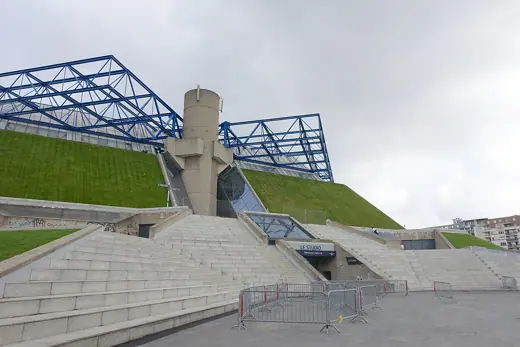
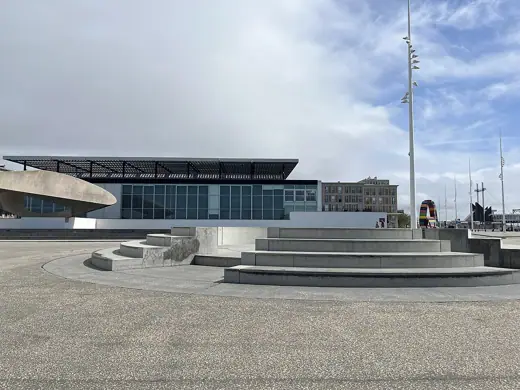
The Maison du Peuple, Clichy (1939), with the architects Eugène Beaudouin and Marcel Lods and the engineer Vladimir Bodiansky, is a historic monument. For MuMa (Musée d'art moderne André Malraux) in Le Havre (1961), designed by Atelier LWD, he made the aluminium louvres above the roof that control the light flooding in. The Accor Arena (Palais omnisports de Paris-Bercy) (1984), designed with Andrault-Parat and Aydin Guvan, is a pyramid whose sloping walls are covered in lawn.