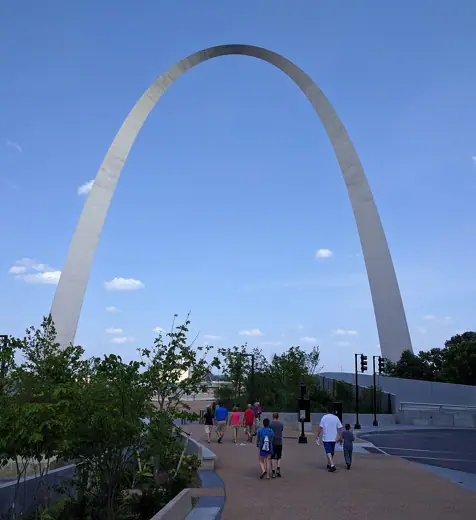
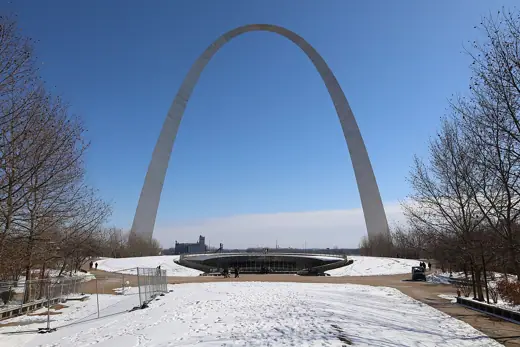
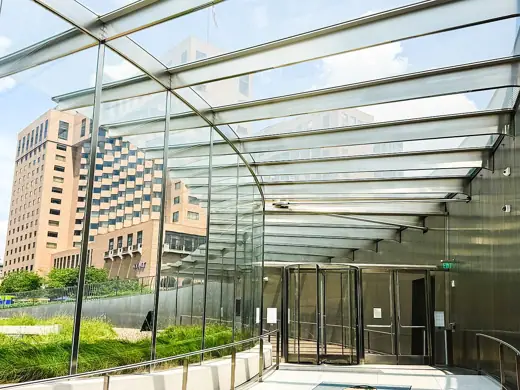
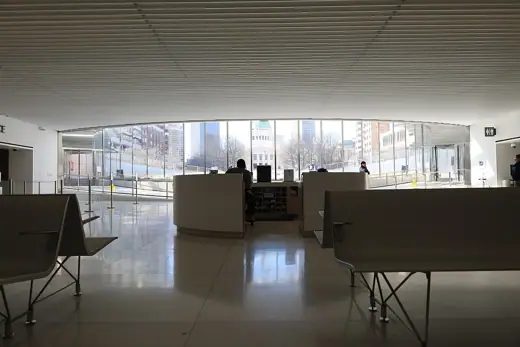
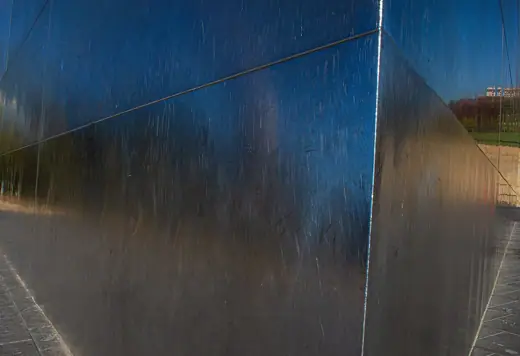
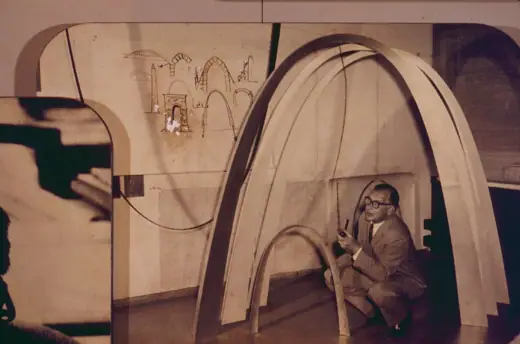
1/7 · Exterior · The Gateway Arch in StPhoto: Lewis Hulbert · CC BY-SA 4.0 · source2/7 · Exterior · Gateway Arch in StPhoto: Antony-22 · CC BY-SA 4.0 · source3/7 · Exterior · Gateway Arch in StPhoto: Antony-22 · CC BY-SA 4.0 · source4/7 · Interior · A glass revolving door with another door that enter inter into the Visitor CenterPhoto: G1B71 · CC0 · source5/7 · Interior · Interior of the Gateway Arch Visitor Center entrance pavilion in StPhoto: Antony-22 · CC BY-SA 4.0 · source6/7 · Detail · Shiny silver panel and welds on the Gateway Arch shot close-up so the blue sky is reflected in the steelPhoto: NPS Photo · Public domain · source7/7 · Model · Eero Saarinen with a model of the Gateway ArchPhoto: Unknown author Unknown author · Public domain · source
Memorial · Late modernism
Gateway Arch
Eero Saarinen · St. Louis, United States · 1965
Key featuresWeighted catenary arch of triangular stainless-steel-clad sections, with tram cars running up its legs.
The Gateway Arch is a 630-foot-tall (192 m) monument in St. Louis, Missouri, United States. Clad in stainless steel and built in the form of a weighted catenary arch, it is the world's tallest arch and Missouri's tallest accessible structure. Some sources consider it the tallest human-made monument in the Western Hemisphere. Built as a monument to the westward expansion of the United States and officially dedicated to "the American people", the Arch, commonly referred to as "The Gateway to the West", is a National Historic Landmark in Gateway Arch National Park and has become a popular tourist destination, as well as an internationally recognized symbol of St. Louis.
The Arch was designed by the Finnish-American architect Eero Saarinen in 1947. Construction began on February 12, 1963, and was completed on October 28, 1965, at an overall cost of $13 million (equivalent to $98.4 million in 2024). The monument opened to the public on June 10, 1967.
It is located at the 1764 site of the founding of St. Louis on the west bank of the Mississippi River.





.jpg)
