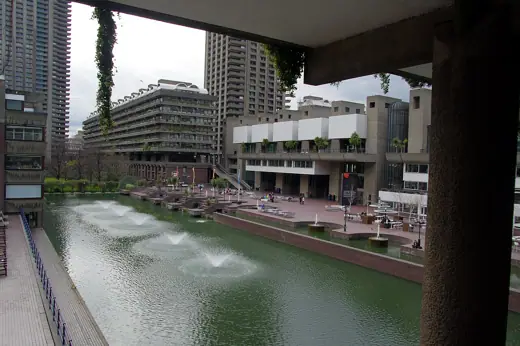
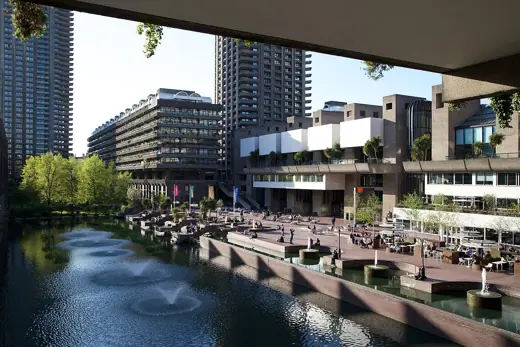
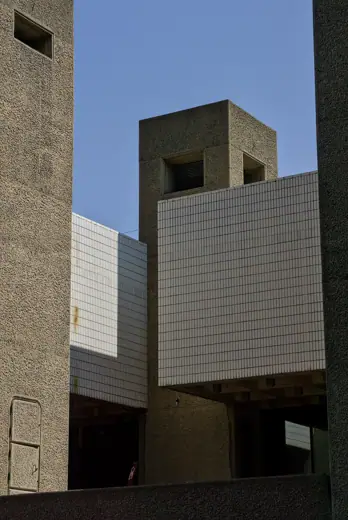
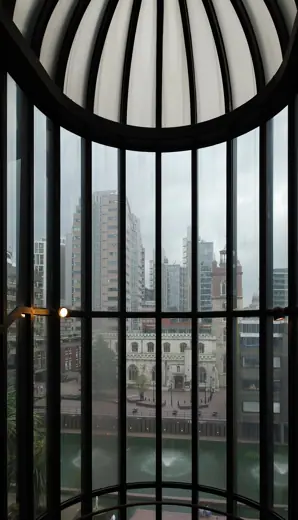
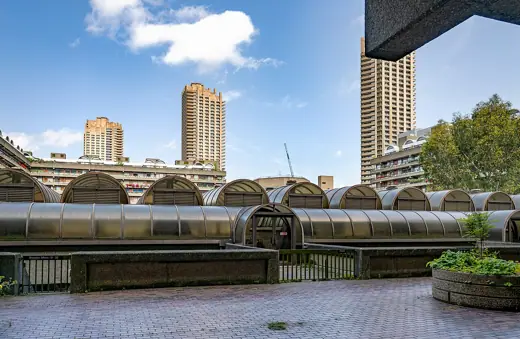
1/6 · Exterior · 8.4.16 From the South Bank to The BarbicanPhoto: donald judge · CC BY 2.0 · source2/6 · Exterior · BarbicanPhoto: Tom Parnell from Scottish Borders, Scotland · CC BY-SA 2.0 · source3/6 · Exterior · View towards the Barbican Arts Centre from Defoe PlacePhoto: Polibil · CC BY-SA 4.0 · source4/6 · ExteriorPhoto: Danteflorence · CC BY-SA 4.0 · source5/6 · Interior · Looking out over the City of London from the staircase of the Barbican Centre Photo: mattbuck ( category ) · CC BY-SA 4.0 · source6/6 · Interior · A plate of fish and chips at the Barbican Centre food hallsPhoto: Daniel Case · CC BY-SA 3.0 · source
Culture & sport · Brutalism
Barbican Centre
Chamberlin, Powell and Bon · London, GB · 1982
Key featuresArts centre buried below a raised podium of walkways, lakes and bush-hammered concrete towers.
The Barbican Centre is a performing arts centre in the Barbican Estate of the City of London, England. The centre hosts classical and contemporary music concerts, theatre performances, film screenings and art exhibitions. It also houses a library, three restaurants, and a conservatory. The Barbican Centre is a member of the Global Cultural Districts Network.
The London Symphony Orchestra and the BBC Symphony Orchestra are based in the centre's Concert Hall. In 2013, it once again became the London-based venue of the Royal Shakespeare Company following the company's departure in 2001.
It was built as the City of London's gift to the nation at a cost of £161 million (equivalent to £574 million in 2025), and was officially opened to the public by Queen Elizabeth II on 3 March 1982. Together with the Southbank Centre, a similar arts centre, the Barbican Centre is also known for its brutalist architecture.



.jpg)
.jpg)
.jpg)


